


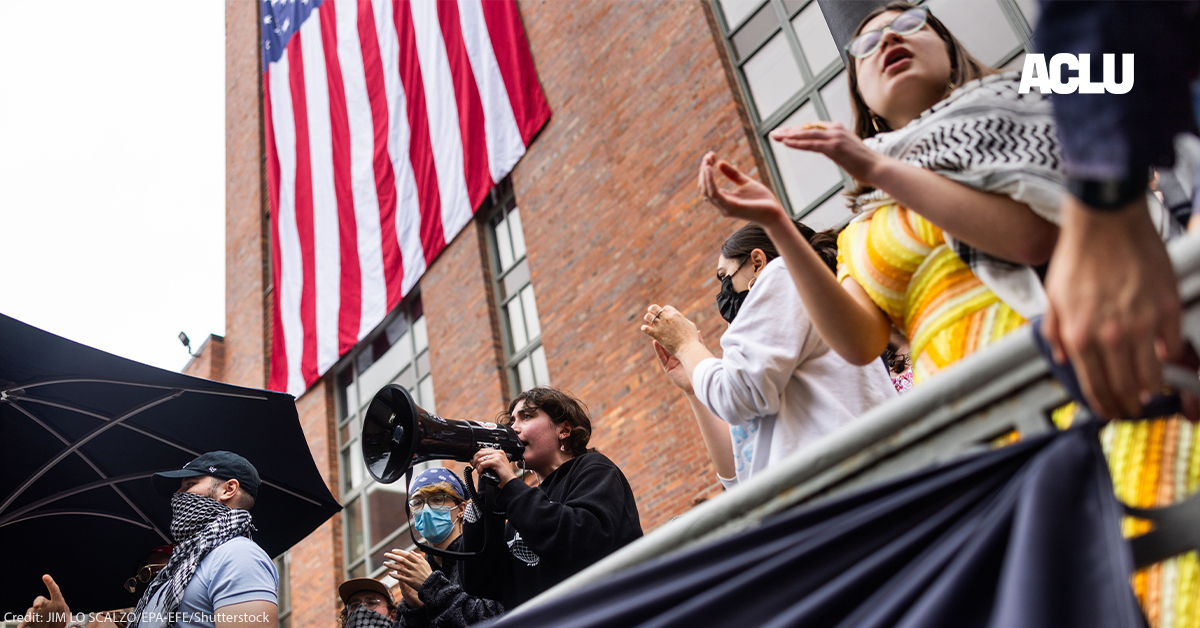
Last Spring, protests related to the ongoing Israel-Palestine conflict engulfed universities across the country, with students and faculty weighing in on both sides of the issue. The ACLU expressed its strong opposition to any efforts to stifle free speech and association on college campuses.
During student protests at Columbia University in April 2024, the Columbia chapter of the American Association of University Professors (Columbia-AAUP), an organization of Columbia University faculty, issued a public statement condemning the school’s punitive response to students protesting the war in Gaza. The statement minced no words, describing then-President Minouche Shafik’s unilateral decision to authorize the NYPD to arrest student protestors as “a grotesque violation of norms of shared governance.” It described Shafik as “inaugurating a new era at Columbia,” marked by “repressed speech, political restrictions on academic inquiry, and punitive discipline against the University’s own students and faculty.” Columbia-AAUP, whose mission is to protect academic freedom and advocate for faculty and students, pledged to provide “continued support for our students’ right to protest and to speak freely, and for our colleagues’ right to teach and to write freely within their domains of expertise.”
Two months later, five current and former Columbia students filed a civil lawsuit in New York against Columbia AAUP in response to this and similar statements. The lawsuit names 21 people and organizations — including Columbia students and faculty, student organizations, the UAW, and three members of Congress — who publicly protested the war in Gaza or who made public statements in support of student protestors.
On behalf of Columbia-AAUP, the ACLU and the civil rights firm Wang Hecker LLP filed a motion to dismiss the lawsuit and to order the plaintiffs to pay our client’s legal fees. We argue that the lawsuit is a clear example of a SLAPP, or “Strategic Lawsuit Against Public Participation.” These cases weaponize our legal system to punish and silence constitutionally-protected speech.
SLAPP lawsuits have become a common tool for intimidating and silencing criticism—including from whistleblowers, journalists, and political protestors. The real goal of a SLAPP suit is not necessarily to win in court, but to entangle people in expensive litigation, using the prospect of mounting legal fees and a potentially ruinous financial penalty to chill speech. In other words, to bully people into silence.
The plaintiffs claim that because Columbia-AAUP spoke in support of student protestors, it somehow injured them by causing Columbia University to move classes online, restrict campus access, and cancel commencement. The plaintiffs have sued Columbia-AAUP for purported monetary and punitive damages resulting from Columbia University’s actions.
If this feels like a logical leap, that's because it is.
Fortunately, New York State—along with 33 other states and the District of Columbia—has an “anti-SLAPP” law specifically designed to protect those whose speech is targeted by such meritless lawsuits. Under New York’s law, a defendant may quickly move to dismiss a lawsuit based on public speech in connection with any issue of public interest—like a statement from professors about the treatment of student protesters on their campus. In a typical civil lawsuit, the defendant must prove that the case has no legal basis in order to dismiss it at the outset. By contrast, the anti-SLAPP law shifts the burden to the plaintiff to prove that there is a “substantial basis” for the claims. If the plaintiff cannot meet this burden, the court must not only dismiss the case, but also order the plaintiff to pay the defendant’s attorney’s fees. The purpose of the fee award is to ensure the defendant is not left with a hefty financial burden simply from fighting off a frivolous case and to dissuade others from filing such lawsuits in the future.
Columbia-AAUP’s case is exactly the type of lawsuit anti-SLAPP laws are designed to quickly dismiss and deter. The allegations against Columbia-AAUP focus exclusively on public statements that the faculty organization made in support of students’ rights to free speech and criticizing Columbia’s crackdown, including using the NYPD, on protesting students. These are issues of clear public interest; indeed, they have captured national attention. And it is clear there is no “substantial basis” for holding Columbia-AAUP liable for this speech, when there is no plausible connection between Columbia-AAUP’s words and Columbia University’s reaction to the student protestors.
Throughout American history, students have participated in and benefited from the marketplace of ideas on college campuses, particularly with respect to pressing and divisive social and political issues. Columbia University itself has frequently been a site of vibrant student protest, including with respect to the Vietnam War, South African Apartheid, and climate change. In this case, the unnamed plaintiffs are free to disagree with the student protestors’ message and those who defended their rights to free speech, but they cannot hold them legally liable for engaging in the rich tradition of dissent that characterizes American campuses.
At the ACLU, we won’t stand for SLAPP lawsuits that imperil this historic tradition and threaten the First Amendment rights of future generations of students, professors, and activists. New York’s anti-SLAPP law, and the First Amendment, clearly protect Columbia-AAUP’s speech–and we are confident that the court will send a clear message that New York will not allow abuse of the legal system to silence viewpoints simply because some people don’t like them.


