



The Trump administration’s three executive orders targeting diversity, equity, inclusion, and accessibility (DEIA) initiatives take a “shock and awe” approach that upends longstanding, bipartisan federal policy meant to open doors that had been unfairly closed. In his first few days, President Donald Trump is undertaking a deliberate effort to obfuscate and weaponize civil rights laws that address discrimination and ensure everyone has a fair chance to compete, whether it’s for a job, a promotion, or an education.
With these actions, the administration is not only undoing decades of federal anti-discrimination policy, spanning Democratic and Republican presidential administrations alike, but also marshalling federal enforcement agencies to bully both private and government entities into abandoning legal efforts to promote equity and remedy systemic discrimination. Trump’s executive orders undermine obligations dating back to the Johnson administration that firms doing business with the U.S. government and receiving billions in public dollars are held to the highest standards in remedying and preventing bias.
For decades, federal policies have supported efforts to promote equal opportunity, enforced by administrations from both parties. These policies grew out of federal anti-discrimination laws passed during the 1960s civil rights struggle and have been expanded to guarantee that opportunity was not denied — as it had been for too long — because of one’s race, gender, sexual orientation, gender identity, disability, or other legally protected characteristics.
Trump’s executive orders represent a major departure from these policies, particularly in the federal contracting space. One order rescinds Executive Order 11246, a cornerstone of equal opportunity policy for federal contractors that has been in place since 1965 under the Johnson administration, without offering any replacement framework. This abrupt shift abandons a measure that has helped dismantle entrenched race and sex segregation in high-paying industries historically closed to women and Black and Brown workers. It also leaves contractors scrambling to navigate a complex regulatory environment, including federal anti-discrimination laws like Title VII and other laws mandating federal contractors take affirmative action with respect to veterans and disabled workers — all of which remain in place.
More broadly, the orders seek to intimidate all employers — ranging from private organizations and federal contractors and grantees to state and local entities — into abandoning DEIA initiatives, using vague and threatening language to create fear of enforcement actions. The strategy is clear: Bully everyone into dropping programs that ensure equitable workplaces by falsely equating diversity efforts with discrimination.
Yet, in employment for example, properly designed DEIA programs are not only legal under federal and state civil rights laws and longstanding legal precedents; they are also necessary to ensure compliance with those laws. Programs labeled as DEIA encompass a broad range of lawful initiatives that create fairer workplaces and ensure opportunities aren’t limited based on race, ethnicity, disability, sex, sexual orientation, or gender identity. Many of these initiatives are not focused on selecting specific candidates for hire — they aim to create fairer processes. For instance, recruiting at underrepresented institutions or ensuring fairness in promotion criteria helps address systemic inequities without disadvantaging any individual.
These programs are not discriminatory; they are essential to creating environments where everyone has a chance to succeed and addressing persistent barriers for individuals to advance in their careers. Employers must take a stand against this political intimidation and remain committed to opening doors to all candidates, especially those facing unfair headwinds. Legal advocacy groups and state attorneys general have urged compliance with federal anti-discrimination laws while advancing equity through measures that are neutral to race and other protected characteristics. Abandoning these programs risks perpetuating inequality, alienating diverse talent, and violating equal employment laws. Simply put, the federal government should not be intimidating and coercing employers into abandoning their commitment to equal opportunity in the workplace.
The executive orders also target DEIA and necessary practices in higher education institutions and schools. These actions mischaracterize lawful equity programs as discriminatory, aiming to chill efforts to promote equal access in education.
The Supreme Court’s decision in Students for Fair Admissions, Inc. v. Harvard left colleges and universities with several pathways to advance educational equity. The decision had no bearing on K-12 education, where schools must continue to identify and address barriers to equitable learning environments.
At a minimum, schools are required to comply with federal and state civil rights laws that ensure educational opportunities are provided on an equal basis. This means reviewing policies and practices to ensure they don’t unnecessarily limit opportunities based on race or other protected characteristics. Schools must also work to foster a climate where all students can access and thrive in their educational pursuits. Now, more than ever, educational institutions must resist intimidation and reaffirm their commitment to identifying and removing barriers to equal opportunity.
Programs labeled as DEIA encompass a broad range of lawful initiatives that create fairer workplaces and schools. The executive orders attempt to conflate these lawful efforts with discrimination, weaponizing enforcement to bully institutions into abandoning critical programs and taking steps to try to eliminate protections against discrimination by government contractors. However, no court has declared DEIA efforts inherently illegal, and President Trump cannot override decades of legal precedent.
Companies, schools, and institutions must resist the fear and confusion these executive orders are designed to create. Now is the time to double down on our commitment to equal opportunity, ensuring that everyone, regardless of their background, has a fair chance to thrive. The ACLU continues to stand firm against these actions. DEIA expands opportunity in our nation by improving education, helping businesses grow, and giving all communities a chance to thrive and succeed.
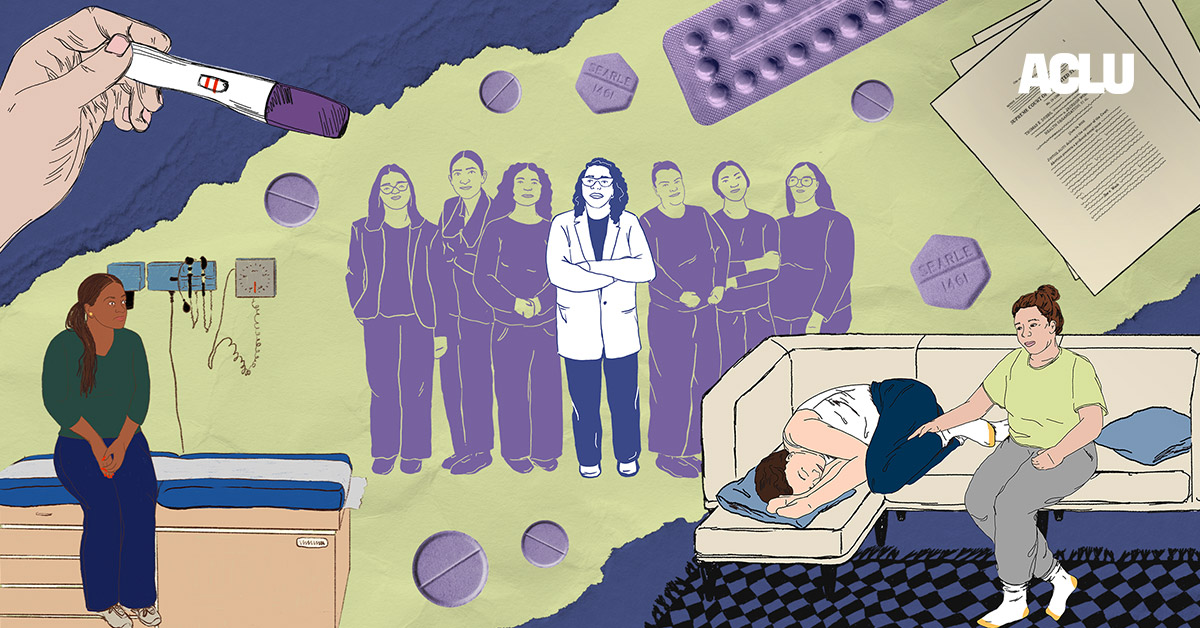
To protect storytellers’ identities, some names have been changed.
Sixteen states currently have total abortion bans or ban abortion before most people recognize they’re pregnant. That’s more than a quarter of our country where individuals are denied the right to make decisions about their bodies.
At the ACLU, we know that abortion is health care. We stand with the people fighting to preserve, expand and restore our rights to this basic health care. Since Roe v. Wade was overturned in 2022, voters have continued to turn out in favor of protecting abortion access. During the 2024 election, seven states, including several that supported Donald Trump, voted to secure abortion access. These wins indicate just how important reproductive freedom remains to people across the country — and across party lines.
Today, as President Trump once again returns to office, anti-abortion politicians are pushing him to ignore the will of the people and misuse the Comstock Act, an antiquated law from 1873, to attempt to ban abortion nationwide, even in states where it is protected today. These extremists also want to ban medication abortion and to prosecute people who help those who live in states with abortion bans find care. And soon we will learn whether the Trump Administration intends to disregard the longstanding protections of the federal Emergency Medical Treatment and Labor Act — EMTALA — and allow anti-abortion state lawmakers to ban emergency, including life-saving, abortion care altogether.
The ACLU will not stop fighting for the ability of every individual to access abortion care, no matter where they live. Access to abortion is not just about politics. It’s about people. Ahead of the 2024 election, we spoke with three individuals impacted by abortion bans in Wisconsin, Alabama and Texas.
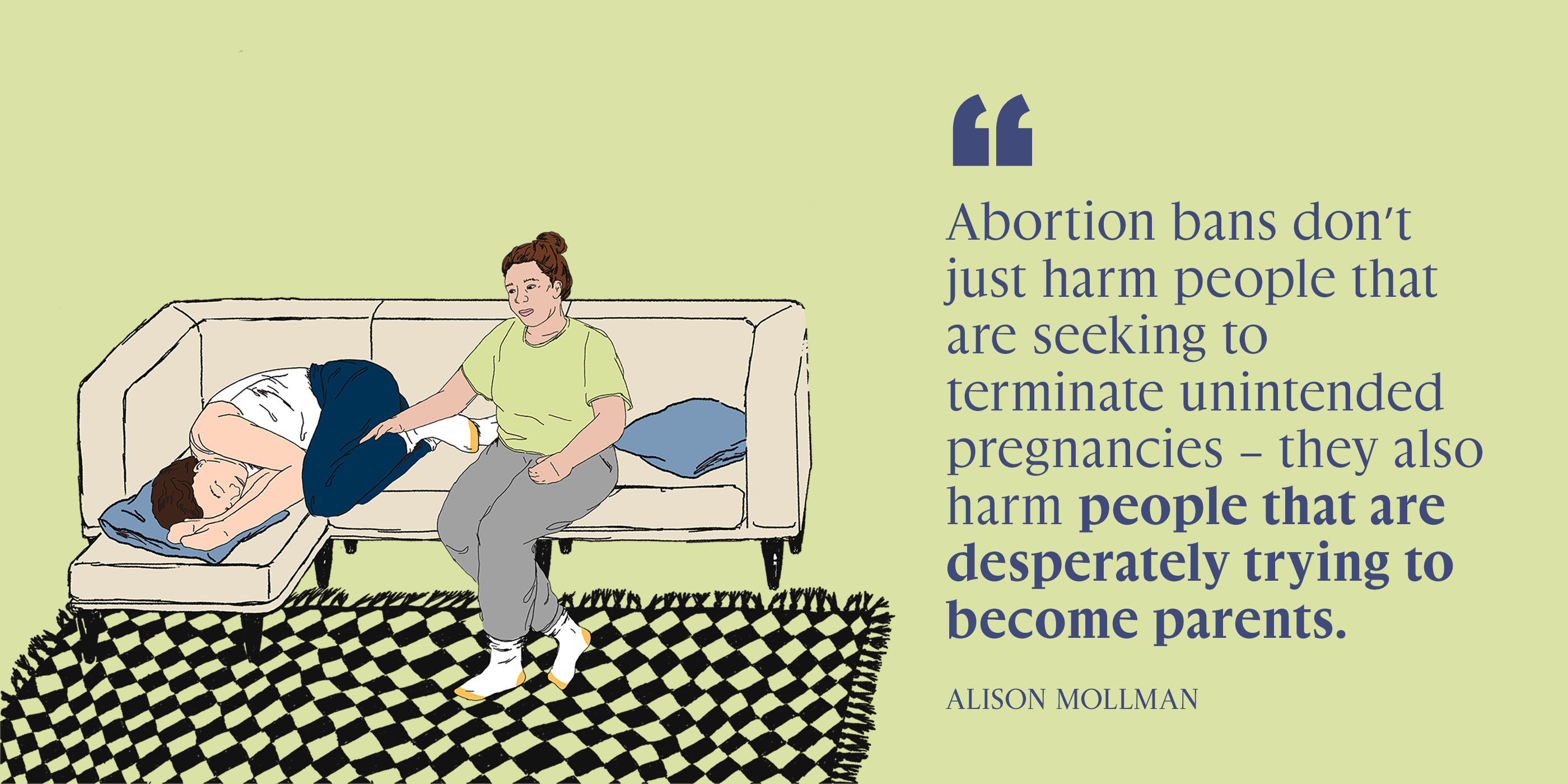
Alison Mollman was seven weeks pregnant when she started bleeding. Through tears, her OBGYN said that she was sorry there was nothing she could do. Mollman thought she meant she regretted not being able to save her pregnancy. It wasn’t until Mollman began to miscarry at home that she realised that her OBGYN meant that she was sorry she couldn’t offer Mollman abortion care, like medication abortion or a D&C, which would have made her miscarriage much faster and less painful.
“It was terrible,” Mollman, the legal director of the ACLU of Alabama, says. “I didn’t have any supportive care. I was told to just go to the emergency room if I started bleeding heavily. I was basically on my own.”
As part of a queer couple trying to become parents, Mollman anticipated trouble accessing fertility care in Alabama, which, in addition to banning abortion outright, passed a law declaring that embryos created through in vitro fertilization (IVF) should be considered children. Several of the state’s IVF clinics paused services for fear of violating the law.
Mollman conceived through at-home insemination, but still faced discrimination in her efforts to receive medically-necessary care when two more of her pregnancies ended in miscarriage. At one point, despite being advised that she was likely miscarrying, an ultrasound tech said that there could be fetal cardiac activity that may be undetectable, which made her ineligible for a D&C. At another time, while in severe pain, she was forced to rely on over-the-counter painkillers.
“It was so hard on my body,” Mollman remembers. “I didn’t know if I could keep doing this.”
Complicating the issue in Alabama, Mollman points out, is the confusion. Doctors and patients, fearful of violating the state’s abortion ban, don’t know when they can or can’t provide care, especially abortion care, to people in crisis. “I don't blame my doctors – I know they don’t want their patients to suffer,” Mollman says. “I blame anti-abortion politicians.”
Mollman and her partner have decided to try to conceive again, despite knowing Mollman may once again be denied reproductive care. Mollman’s experiences continue to motivate her in her work to fight abortion restrictions. Right now, with the ACLU of Alabama, Mollman is taking the Alabama attorney general to court because he threatened to prosecute anyone who assists Alabamaians in traveling to another state to access legal abortion care. It’s a tough battle, Mollman says, but one she won’t stop fighting.
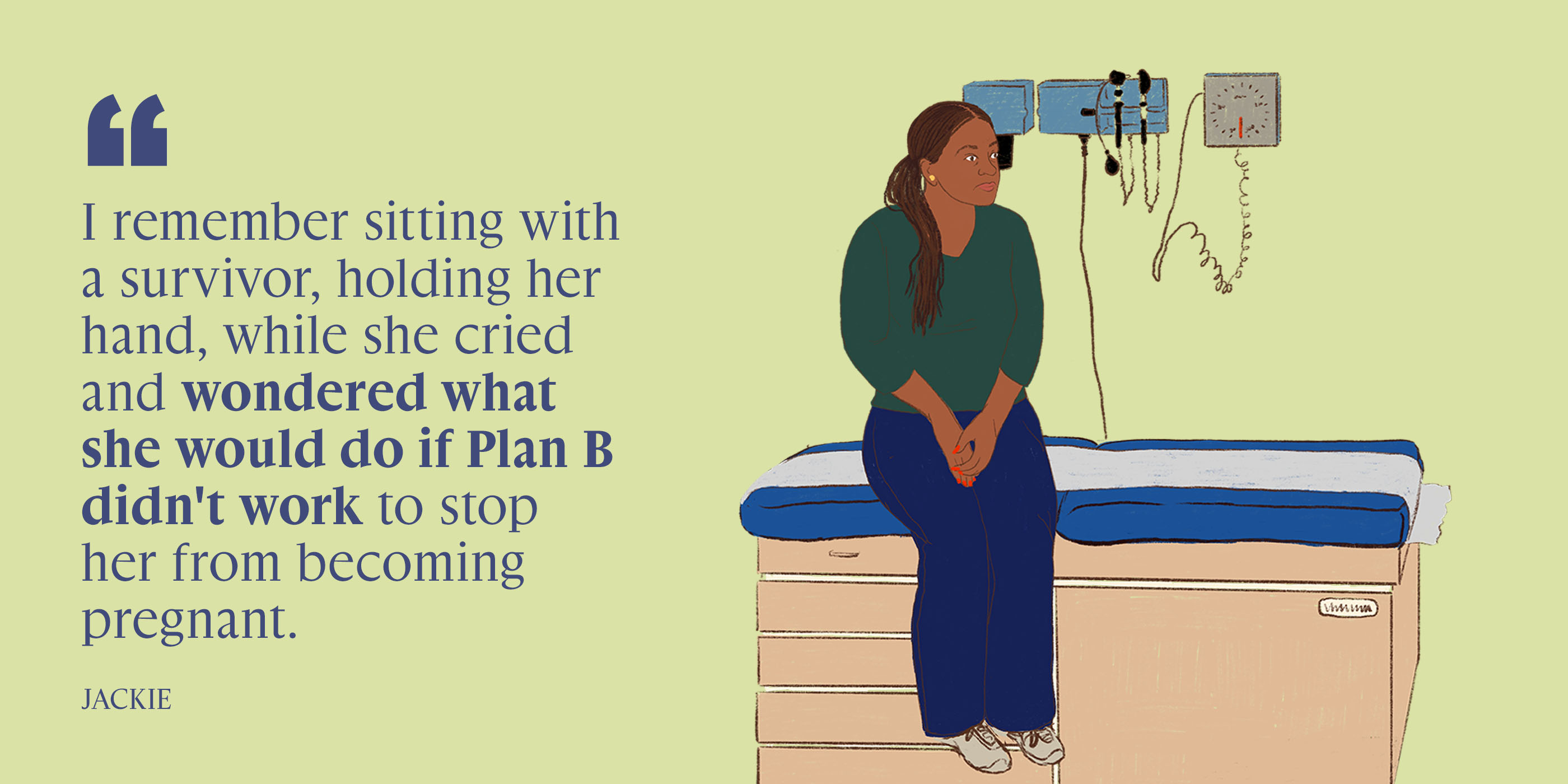
Jackie has spent nearly six years as a rape crisis and domestic violence counselor in Wisconsin. She’s assisted many people on the worst nights of their lives, helping them work through trauma and feel safe again. Shortly after Roe was overturned, Jackie was supporting a survivor when the question of Plan B came up. There was concern that Plan B might fail and she could become pregnant at the time when Wisconsin had recently banned abortion.
It was “really scary” to think about what might happen if Plan B didn’t work, Jackie recalls. “At that point, you could be assaulted, go to the hospital and have no options. You can’t get an abortion. There’s just nothing you could do,” she says.
The idea that survivors could be denied the right to make choices about their body is horrifying to Jackie, who is also a survivor of sexual assault. She recalls how having control returned to her and being able to stand up for her health was vital to her ability to heal. “It’s a violation,” Jackie says, “to force people to carry [their abuser’s child]. It’s traumatic. It’s heartbreaking.”
While abortion is now available in Wisconsin due to a court decision, the case is still working its way through the legal system and Wisconsinites could once again lose access to this necessary medical care. Jackie fears that, even if a future abortion ban made an exception for assault survivors, so many people would still be forced to carry pregnancies against their will because sexual assault remains underreported. Jackie is also concerned about the impact abortion bans could have on survivors of domestic violence. It’s a common tactic for abusers to coerce or force their victims to become pregnant. Without access to abortion care, many domestic violence victims must choose whether to stay with their abusers, or raise a child on their own.
Jackie remains hopeful that abortion care can be enshrined into the Constitution once again. Until that day, she hopes that everyone will disrupt the anti-abortion agenda as much as they can. “Call your lawmakers, stand outside their offices, yell at them. Talk to your friends and community about your views and experiences. Being a voice is so important,” she says.
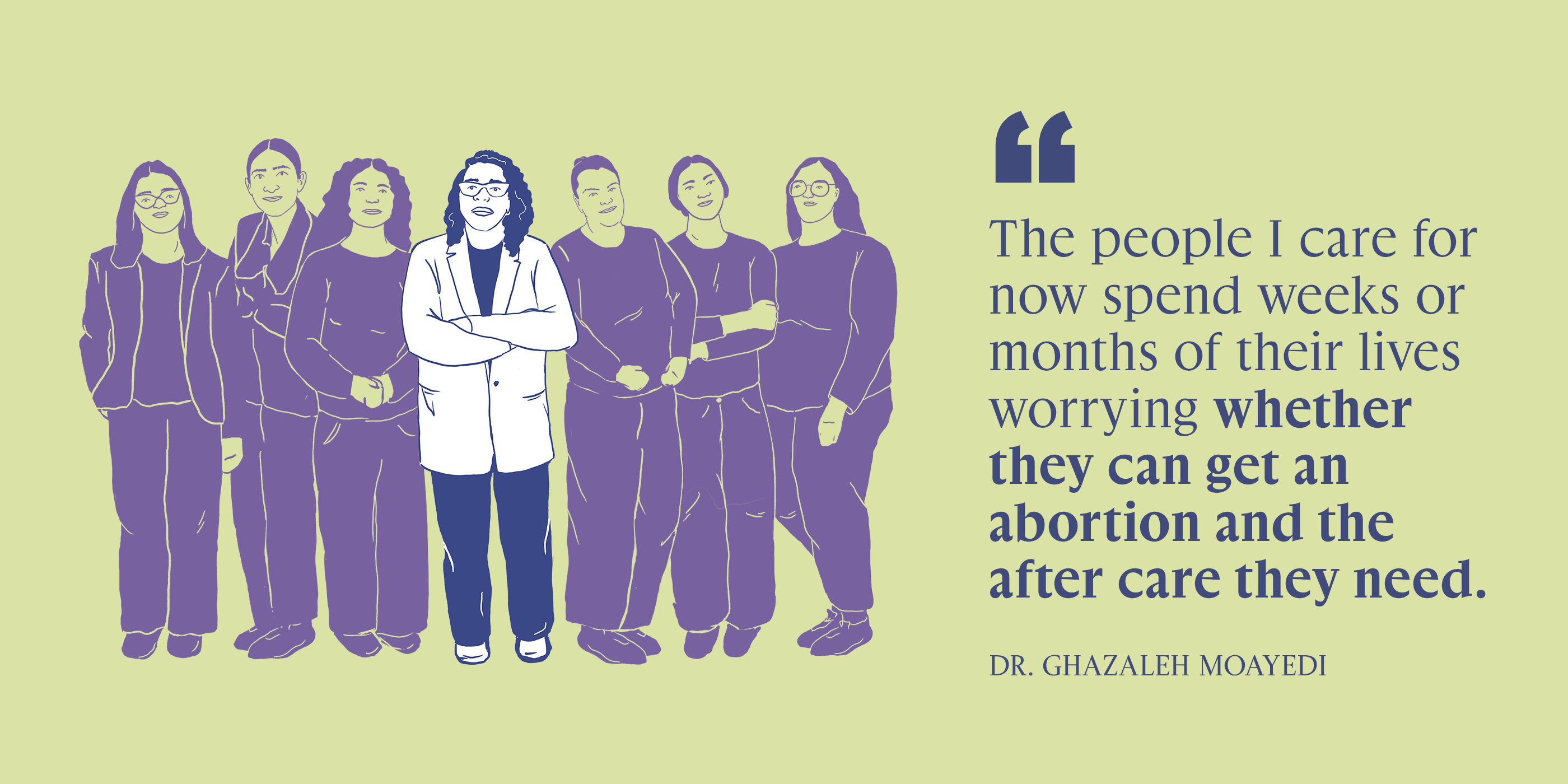
Dr. Ghazaleh Moayedi saw firsthand how the racial and structural barriers she’d faced growing up made it difficult for Black, brown and immigrant patients to access abortion are in Texas. She became an OBGYN to be an abortion provider and help these communities access the care they deserved. But, just three years after she finished her training, Texas banned abortion.
Moayedi now travels out-of-state to provide abortion care for people from states with bans. She also provides pre and post-abortion care in Texas for patients who receive abortions where care is legal. A big part of her work is not just providing hands-on care in an exam room, but navigating the policies of each region, educating other providers, and figuring out how to get her patients the care they need.
“It is my duty as a doctor to advocate and agitate. When Roe was overturned and it wasn’t clear if Texas law prevented abortion providers from caring for Texans out of state, I sued the state, which was a scary thing to do.”
“Abortion bans have caused so much anxiety and uncertainty, for both providers and patients. People of color, young people, people from rural areas and people with low socioeconomic status face barriers that add additional stress,” Moayedi says. “I’ve taught abortion care across Texas for many years, and my trainees are now vocally pro-abortion in a way that is refreshing. Abortion is an everyday part of life that is just completely normal.”
For more than 50 years, Roe v. Wade protected abortion access at the federal level. Extremist politicians have continuously attacked reproductive freedom and they will not stop until abortion is banned in all 50 states. Trump’s advisors want him to bend and break the law in order to carry out their own political agenda to deny people the fundamental right to make personal medical decisions. But during the campaign he promised not to further restrict access to abortion, and he needs to keep his word.
If Trump breaks his promises, the ACLU stands ready to hold him accountable. We’ll continue to fight abortion restrictions in court, including defending against misuse of the Comstock Act or attempts to ban mifepristone. We’ll also fight back against efforts in Congress to further restrict reproductive rights.
At the ACLU, we know how important this fight is for people across the country who deserve the right to make decisions about their bodies.


.png)