


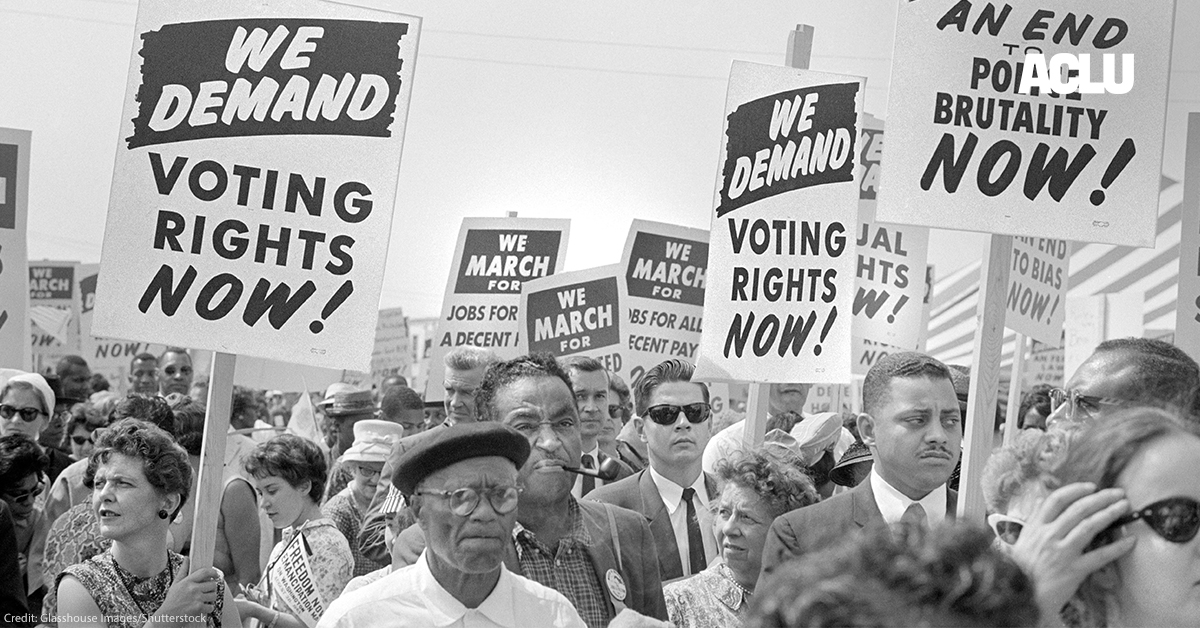
This August marks 60 years since President Lyndon B. Johnson signed the Voting Rights Act (VRA) into law. The act is the crown jewel of civil rights legislation and seeks to finally make the Constitution's promise of equality real. In the past year alone, the ACLU was in federal court wielding this very law to ensure that Black voters have an equal opportunity to participate in the political process in Alabama, Georgia, Louisiana and Mississippi. These two realities capture where we are: celebrating the VRA's legacy, while fighting desperately to save it from destruction.
At the ACLU's Voting Rights Project, we’ve relied on the VRA to combat discrimination, litigating at least 16 cases under the act in the past decade alone. But increasingly, we’re fighting to save the act itself.
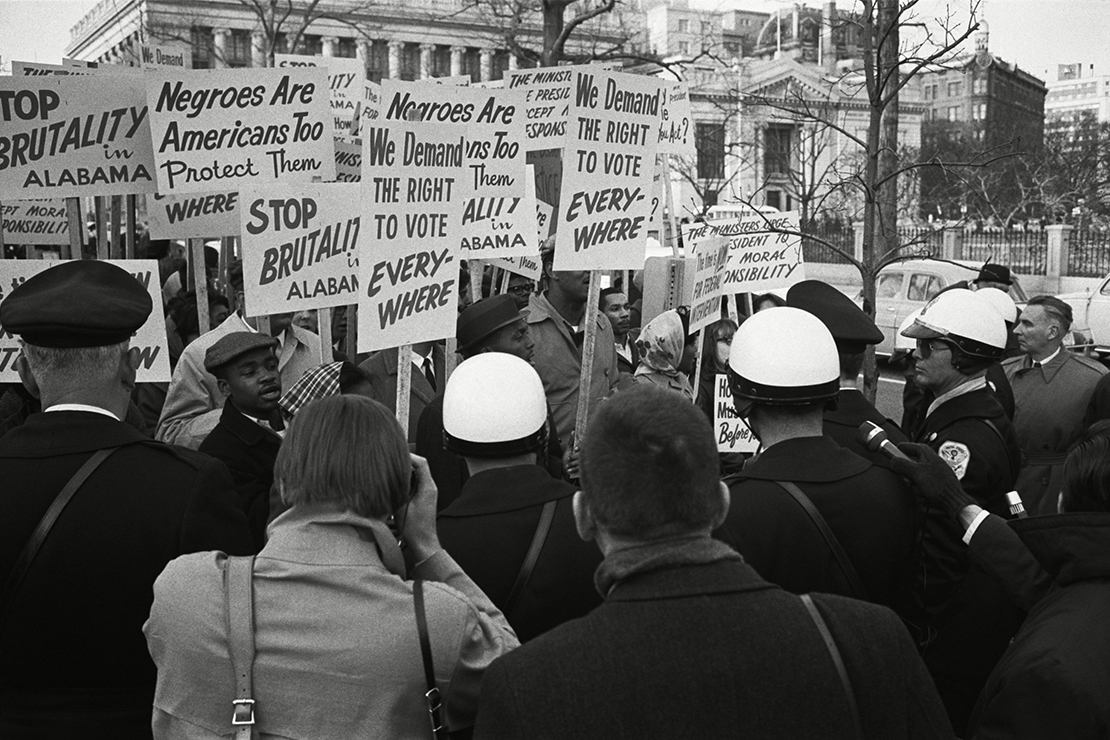
On March 12, 1965, Black demonstrators gathered outside the White House to protest in solidarity with demonstrators in Selma.
Everett/Shutterstock
I've seen what happens when this pillar stands strong. I've watched judges strike down discriminatory laws, jurisdictions open polling places under threat of litigation, and citizens previously denied access cast their ballots. Yet these victories only tell half the story. I've also seen what happens when we can't use it—voters turned away, communities silenced, democracy denied. Since a deeply consequential 2013 Supreme Court decision, state legislatures have mounted a coordinated attack on voting access and introduced hundreds of voter suppression bills. Each case represents thousands of voters—real people whose fundamental rights hang in the balance.
What makes these attacks especially dangerous is that they're happening just as the Voting Rights Act—a law constructed specifically to stop such attacks—is threatened with systematic destruction. We're witnessing deliberate structural damage to a crucial pillar supporting American democracy.
Even under siege, this pillar still stands—and still works. The recent victories show what's possible when the VRA operates as intended, and what we risk losing if it falls.
In Allen v. Milligan, we successfully challenged Alabama's congressional map, proving the map violated Section 2 of the VRA by diluting Black voting power. The result: Alabama elected two Black representatives to Congress for the first time in history. Similar victories in Georgia, Louisiana, and Mississippi forced new majority-Black districts after courts found unlawful vote dilution.
These victories demonstrate the VRA's power to restore what discrimination steals. But here's what should terrify every American: The foundation supporting these wins is cracking, and the attacks are accelerating.
The recent onslaught on this democratic pillar began with calculated design. In the 2013 case, Shelby v. Holder, the Supreme Court knocked out a crucial beam—what’s known as preclearance, a provision that requires certain jurisdictions with a record of racial discrimination in voting to obtain federal approval before making any changes to their voting laws or practices. Preclearance was one of the VRA’s most powerful preventive tools against voter discrimination. It worked like a safety net—catching discriminatory voting changes before they could harm voters. Like a building with compromised structural integrity, after preclearance was eliminated, democracy in covered states immediately suffered. Texas announced, Senate Bill 14, its restrictive voter ID law within hours. North Carolina crafted restrictions—eliminating same-day registration, reducing early voting, and creating a new photo ID requirement—within two months of the decision.
The damage spread methodically. In 2021, the Supreme Court’s ruling in Brnovich v. Democratic National Commitee made it harder to prove discrimination under Section 2 of the act, which bans racially-discriminatory voting practices nationwide, weakening yet another support beam. But an even more pernicious assault on the foundation began in the 8th U.S. Circuit Court of Appeals, where courts launched an unprecedented attack on private enforcement of the VRA, or the ability of individuals, groups or private parties to file lawsuits in federal court when their voting rights protected by the VRA have been violated. This further weakened the very mechanism that makes the VRA work.
In a pair of decisions in 2023 and 2025, the 8th Circuit Court ruled that voters cannot sue to protect their voting rights under Section 2. This not only contradicts 60 years of legal precedent, but the very text and purpose of the VRA. The cruel irony in one of those decisions, Turtle Mountain Band of Chippewa Indians v. Howe, is that the Native American tribes who brought the challenge had just achieved historic representation under a court-ordered fair map under Section 2, including the first Spirit Lake Nation member ever elected to the legislature. Now that victory may be erased.
This assault comes at a time when the Department of Justice (DOJ) has abdicated its responsibility to enforce the VRA. While private plaintiffs have brought hundreds of successful voting rights cases since 1982, the DOJ under the current administration has not just reduced its role, but actually withdrawn from active cases and announced new priorities that reveal that combating racial discrimination in voting and ensuring that every eligible citizen has a voice in our democratic processes is no longer of great importance. If the 8th Circuit Court’s view of private enforcement spreads, who will be left to protect voting rights? The victories in Alabama, Georgia, Louisiana, and Mississippi will become impossible. Without private enforcement, this pillar of democracy collapses entirely, leaving voters with no champion—neither citizen advocates nor their own government.
The assault may not be finished. The Supreme Court will have at least three cases involving the VRA before it next term in which our opponents, and the court itself, have raised questions that could lead to even more blows to the law.
The implications of this structural damage are already visible across the country. We've litigated cases where discriminatory intent was undeniable. Without Section 2 and private enforcement, voters facing racial discrimination — especially given the current DOJ’s abdication — would have no recourse.
The precision targeting is unmistakable. In North Carolina, the state’s legislature announced a law just hours after the Supreme Court’s decision in Shelby County that effectively eliminated same-day registration, slashed a week of early voting, and invalidated out-of-precinct ballots for years. These measures had been disproportionately used by Black voters in the 2012 general election, in which almost a million people voted during the week of early voting that the new law eliminated; nearly 100,000 voters registered using same-day registration; and 7,500 cast ballots out of precinct. Eventually, the 4th U.S. Circuit Court concluded that these provisions were enacted with racially discriminatory intent and “targeted African Americans with almost surgical precision.” But the case took 34 months to litigate, and in the interim, 188 federal and elected offices were elected under the unlawful provisions.
The defiance is brazen. In Alabama, just this May, a federal court found the state intentionally discriminated against Black voters in congressional redistricting. The court declared they could see Alabama's actions as nothing “other than an intentional effort to dilute Black Alabamians' voting strength.” Most damning, the court found Alabama had a 'checkmate' strategy—deliberately defying court orders in hopes of forcing another Supreme Court review.
Standing on the Edmund Pettus Bridge in Selma this March, I thought about John Lewis, who nearly died there for the right to vote. He lived to see the VRA's power, and to watch it being dismantled. Before his death, he warned us: "The vote is precious. It is almost sacred. It is the most powerful non-violent tool we have."
That tool is being stolen from us in broad daylight.
Without federal protection, voting rights will depend entirely on state politicians—the very officials who benefit from suppressing the vote. We'll return to a patchwork of democracy where your rights depend on your ZIP code and your skin color.
Today, we're at a crossroads. Either we shore up this pillar with the John Lewis Voting Rights Advancement Act to restore preclearance and protect private enforcement, or we watch it crumble and, with it, the democratic structure it supports.
Sixty years ago, Americans built a pillar strong enough to support true democratic participation. They built it with sacrifice, cemented it with blood, and designed it to bear the weight of every citizen's rights. Today, watching those who would demolish it, I'm reminded that even the strongest pillars need maintenance, reinforcement, and defenders.
The heroes of Selma couldn't have imagined that 60 years later, we'd still be shoring up what they built. But they also couldn't have imagined we'd let it fall. We won't. We can't. The democracy it supports depends on it.


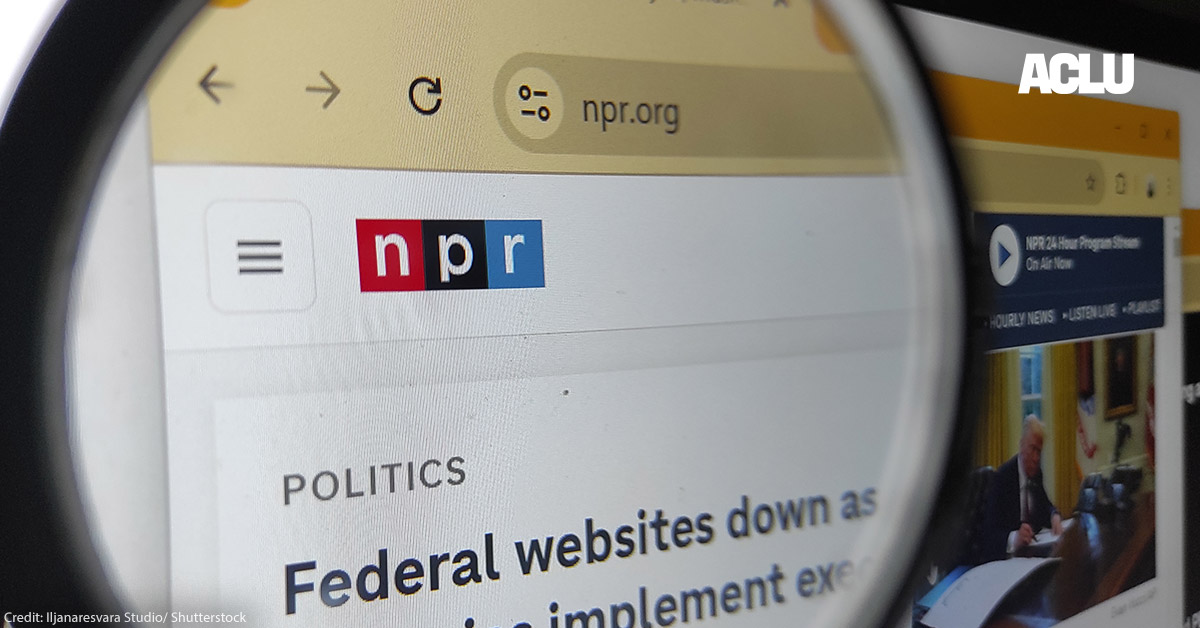
President Donald Trump lobbed a series of attacks aimed at dismantling the free press earlier this year. These attacks include a $1.1 billion cut in public broadcasting funds to NPR and PBS stations, as well as a $10 billion defamation lawsuit against the Wall Street Journal.
Earlier this month, the ACLU filed a friend-of-the-court brief in NPR v. Trump — a case that challenges the Trump administration’s executive order banning the use of congressionally-appropriated funds for NPR and PBS stations. The order, which accused the media outlets of failing to create “fair, accurate, or unbiased” reporting, clearly violates the First Amendment. Government officials should not be able to withhold taxpayer dollars, designated by Congress to promote private speech, from news outlets whose coverage they disapprove. Defunding NPR and PBS stations threatens to leave communities across the U.S. with limited access to local news and educational content, especially in rural areas.
The federal government’s blatant attack on the media is unprecedented in recent history, but not unexpected from a president who has exhibited hostility toward the press for almost a decade. From banning The Associated Press from the White House press pool to suing media companies over their reporting, Trump’s personal and official track record with the media has proven that his administration is willing to dismantle our free press and violate the Constitution.
In our second installment of “Press in Peril,” our series on the value of a free press, we explore how Trump, Congress and regulatory agencies have targeted media organizations for exercising their First Amendment rights.
While attacking publicly funded media, the Trump administration has also targeted outlets and institutions that cover federal affairs at the White House and Pentagon. In one of the administration’s earliest moves against the press, Trump signed an executive order in February banning The Associated Press from the White House press pool for not using Trump’s new name for the Gulf of Mexico. A federal judge ordered the White House to restore the newsroom’s access in April on the grounds that the ban violated the First Amendment. However, that decision was temporarily delayed by the D.C. Circuit with an appeal currently pending.
Despite this win for freedom of speech and the press, the administration has broken from centuries of precedent by restricting press coverage. The White House Correspondents’ Association announced that — after more than a hundred years — it would no longer control the White House press pool in February. By ceding control of that power to the Trump administration, the White House now decides which journalists and news organizations are part of the press pool. Similarly, the Pentagon removed longstanding offices for legacy media outlets such as The New York Times, NPR, and Politico for new media outlets, the majority of which lean conservative in their coverage.
The previous installation of “Press in Peril” covered how New York Times v. Sullivan and the “actual malice” standard seeks to protect the press from high-cost defamation lawsuits for their reporting. However, Trump has not let this precedent stop him from intimidating the press through litigation.
Most recently, Trump filed a $10 billion defamation lawsuit after The Wall Street Journal published a story on a 2003 letter sent from Trump to Jeffery Epstein on his birthday. Denying that he had written the letter, Trump sued Rupert Murdoch, News Corp and their CEO Robert Thomson, Dow Jones & Company, and the reporters who wrote the story. Trump described the piece as a “false, malicious, defamatory, FAKE NEWS" on Truth Social.
The Wall Street Journal is not the only news company that Trump has sued in the past year. He recently settled for $16 million in a lawsuit against Paramount and CBS News for the “60 Minutes” coverage of former Vice President Kamala Harris during the 2024 presidential race. In December, he reached a $15 million settlement with ABC News over a misquotation by host George Stephanopoulos. Trump also threatened to sue The New York Times and CNN for their reporting on the U.S. airstrike in Iran.
Trump has also targeted smaller outlets. He sued the Des Moines Register and Iowa pollster Ann Selzer in December 2024 over a poll that predicted former Vice President Kamala Harris would win the presidential election. Trump called the poll “fraud” and “brazen election interference.” For smaller outlets with fewer resources, these actions raise concerns about the president’s willingness to sue over any unflattering news coverage.
Weeks after he won the 2024 election, Trump appointed Republican commissioner, and Project 2025 author, Brendan Carr as head of the Federal Communications Commission (FCC), which regulates communications across the country.
Since Carr became Chair, the FCC has opened baseless investigations into several media outlets that the president and his administration don’t like, including ABC, NBC, CBS, and local news outlets.
Companies with pending matters before the FCC have made troubling concessions regarding their public and private expression in an apparent effort to obtain favorable business outcomes. For example, the FCC launched an investigation into CBS’s “60 Minutes” for the way they edited an interview with Harris. It’s no coincidence that the FCC launched the investigation after Trump had already sued CBS in his personal capacity. Needing the FCC’s permission for a merger, Paramount — the corporate parent of CBS — settled a $16 million lawsuit with Trump, and announced they would pull back on various diversity, equity, and inclusion (DEI) initiatives. Weeks later, the FCC approved the merger which, among other concessions, included hiring a bias monitor at CBS. Verizon and T-Mobile also agreed to dismantle their DEI programs just days before the FCC approved their respective mergers.
Press protections are integral to the First Amendment, including the right to report without fear of government interference. As more cases like NPR v. Trump reach the courts in future months, the ACLU continues to challenge such actions to uphold the First Amendment. The ACLU is committed to fighting for reporters’ right to hold those in power accountable.


