





As part of President Donald Trump’s attempt to remake the federal workforce, several directives have been issued to terminate recently hired employees and gut entire agencies. Many federal workers have also been urged to resign under the premise that they will be paid through September 2025.
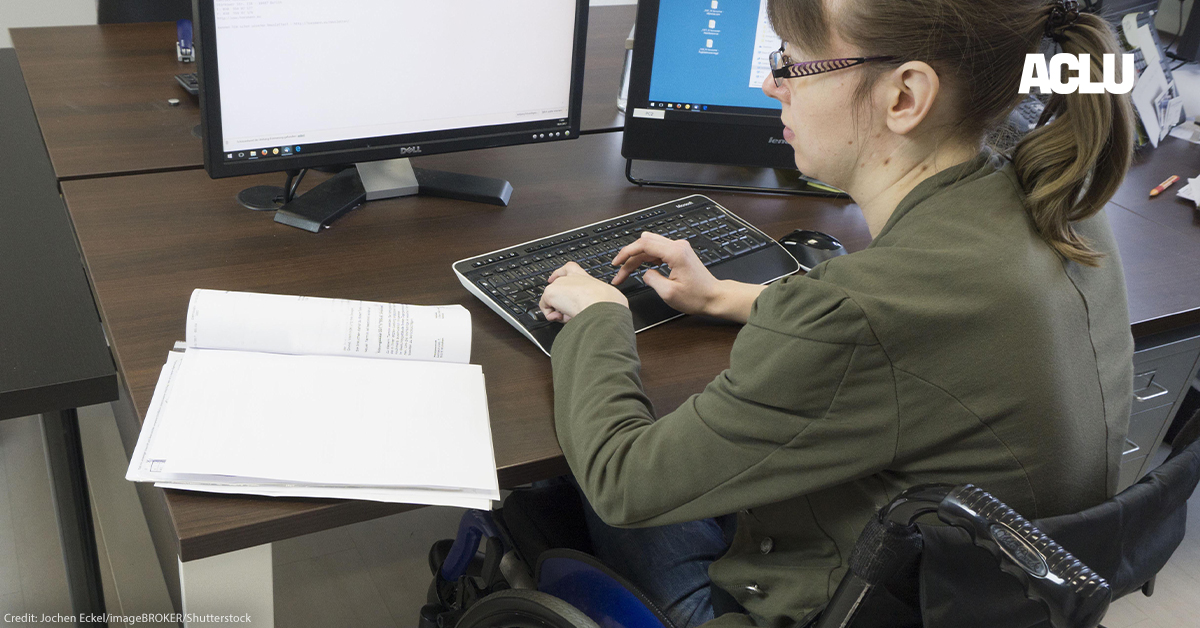
The federal workforce includes hundreds of thousands of well-qualified disabled employees who work at all levels of the federal government. Some disabled employees receive accommodations in the workplace, including an elevated desk that a wheelchair can fit under, interpreters for deaf and hard of hearing employees, or screen readers for people who are blind or low vision.
The entire federal workforce is facing unprecedented fear and uncertainty, but disabled workers face additional struggles as executive orders and damaging rhetoric question their right to receive needed accommodations. At the ACLU, we know that directives from the Trump administration do not change the law. It is still illegal to discriminate against a federal employee because of a disability and the federal government is still required to provide reasonable accommodations that do not cause undue hardship.

ASL Interpretation of Rights of Federal Employees with Disabilities, Explained video
Section 501 of the Rehabilitation Act of 1973 protects qualified individuals with disabilities from discrimination based on disability, specifically in hiring, advancement, discharge, compensation, training, or other terms, conditions, and privileges of employment. It also requires that, unless it would be an undue hardship, agencies must provide reasonable accommodations for the known physical and mental limitations of a qualified individual with a disability.
No, the new orders and policies cannot change the requirements of the Rehabilitation Act, which a memo from the Office of Personnel Management (OPM) acknowledges. OPM states that “agencies should not terminate or prohibit accessibility or disability-related accommodations, assistance, or other programs that are required by [the Rehabilitation Act] or related laws.”
Reviewing an accommodation is permitted, but a reasonable accommodation should not be changed unless an accommodation is no longer necessary, the original accommodation is no longer effective for the employee, or another reasonable and effective accommodation exists.
Despite the Trump administration’s efforts to bring federal workers back into offices for in-person work, if working remotely is needed as a disability accommodation, the employer must still provide it. OPM recognizes this in another memo, writing that federal agencies should require in-person work unless remote work is “due to a disability [or] qualifying medical condition.”
Being pressured by supervisors or co-workers to quit or return to work in-person despite an approved accommodation may be illegal workplace harassment, retaliation for requesting an accommodation, or illegal interference with your right to seek an accommodation. It would also be illegal disability discrimination to target federal employees for layoffs based on their disabilities or need for accommodations.
Similarly, an employer should only ask for medical documentation if the disability or the need for the accommodation is not known or obvious. Such requests are normally made at the time of the original accommodation request. Further documentation may be requested if the disability is one that changes over time. When the employer has a good reason for seeking more documentation, the employer should only ask for reasonable documentation about the disability and about its functional limitations that require reasonable accommodation. Employers must treat any such health information as a confidential medical record.
If you can’t work it out directly with your employer, employees can file a complaint. There are very short deadlines to complain, and you should assume they cannot be extended.
The first step in the complaint process is to make and document an informal complaint with your agency’s Equal Opportunity Employment officer. This must be done within 45 days of the date of the failure to accommodate or other discrimination. But there are also deadlines for each step after that. The full complaint process is summarized in the Overview of Federal Sector EEO Complaint Process on the EEOC website.
It is illegal to retaliate against an employee for making a complaint of discrimination, including a complaint about the failure to accommodate. You should file a separate complaint about any retaliation. There is more information about your rights on the EEOC website. You might start by looking at the EEOC Disability-Related Resources. If you are worried that the information there may have recently changed or may no longer be accurate, you may want to consult a lawyer.
Disabled people belong in the federal workforce and in every part of the political, civic, and economic life of our communities. Donald Trump can’t undo that by fiat – and he hasn’t.
This blog includes excerpts from a frequently asked questions resource prepared by the American Civil Liberties Union, Bazelon Center for Mental Health Law, and the Disability Rights Education and Defense Fund. The full resource, including a list of lawyers who can help answer questions on disability discrimination, can be found here in English and here in American Sign Language.


