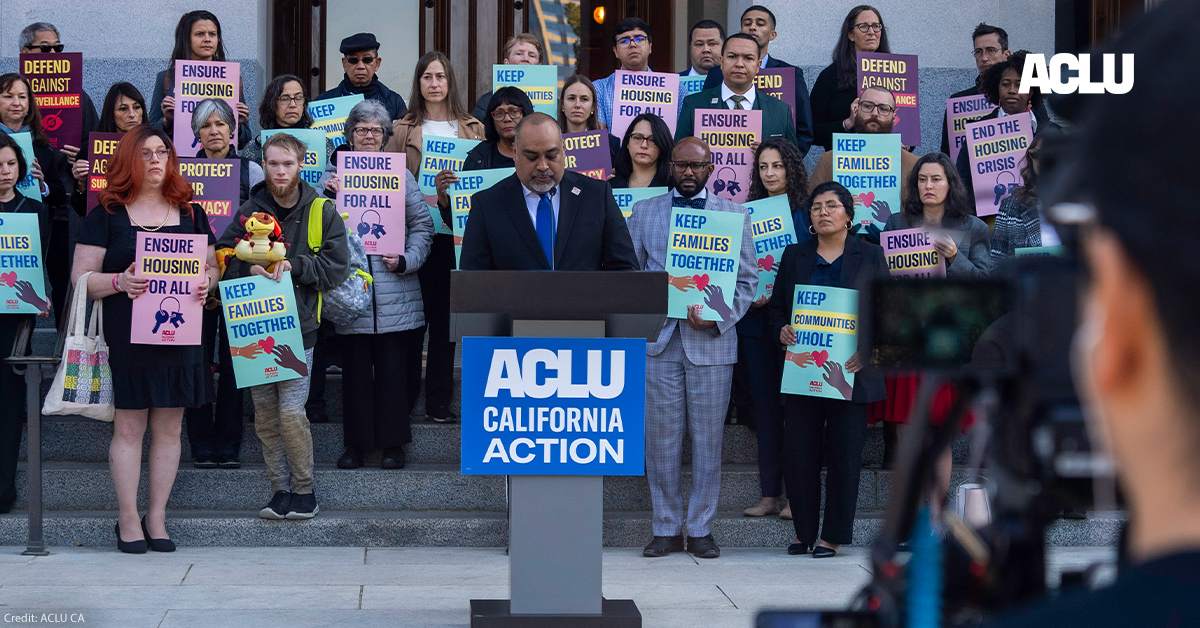
States and cities are on the frontlines of the fight against the second Trump administration’s efforts to restrict our rights — and it is a fight. Already we’ve seen Donald Trump respond to this state-based resistance by attempting to weaponize funding to intimidate local officials to follow his extreme agenda. But local officials not only can fight back — they are fighting back.
For nearly a year, the ACLU has worked with our affiliates in every state to develop a playbook to block and disrupt Trump’s radical agenda. Our playbook outlines comprehensive tools to safeguard reproductive rights, immigrants’ rights, free speech, and more.
At the ACLU, we know that dissent is patriotic. Policymakers and elected officials must act to protect their communities and the rule of law, especially when under threat from the White House. Below are a few ways that states are saying no to Trump’s radical agenda.
Fifteen state attorneys general have formed a coalition to protect gender-affirming medical care for trans youth. They condemned President Trump’s recent anti-trans executive actions “wrong on the science and the law.” New York Attorney General Letitia James went a step further. She warned hospitals that they would be violating state anti-discrimination laws if they stopped offering gender-affirming care to youth.
New York Governor Kathy Hochul signed into law a bill that gives abortion providers additional privacy protections when prescribing medications used for abortion. While more privacy protections are still needed, when signing the bill, Hochul affirmed her commitment to New York being a safe harbor for all who need abortion care.
North Carolina and Washington have also moved to protect reproductive health. In Washington, Governor Bob Ferguson released an executive order convening a task force to strategize on protecting reproductive freedom. Governor Josh Stein issued an executive order reaffirming his commitment to protect women’s reproductive freedom in North Carolina. The executive order directs cabinet agencies to safeguard medical privacy and protects doctors providing lawful reproductive health care.
“We know that the work to fight both federal and state-level threats to our freedoms will happen locally,” said Liz Barber, director of policy & advocacy for the ACLU of North Carolina. “We have already seen the monumental impact of attacks on abortion across the country and here in North Carolina. That’s why we applaud the executive order from Governor Stein that protects access to abortion in North Carolina. We will continue to urge elected leaders to use every power at their disposal to affirm our fundamental rights and work with our coalition partners to sustain access to safe abortions.”
Last month, the ACLU responded to a Justice Department (DOJ) memo threatening local officials with criminal prosecution for refusing to carry out the Trump administration’s mass deportation agenda. The DOJ’s argument was legally baseless and harmful to our communities. Eleven state attorneys general agreed with us. Together, they released a statement noting their duty to uphold state laws.
Attorneys generals in Maryland, Minnesota, and New Mexico also took action. As reports of Immigrations and Customs Enforcement (ICE) raids rose in Maryland, Attorney General Anthony Brown issued guidance on immigration policy for local law enforcement agencies and health care providers. New Mexico Attorney General Raúl Torrez also issued guidance to local leaders in response to Trump's executive order rescinding long-standing federal protections for sensitive locations, such as schools and hospitals. In Minnesota, Attorney General Keith Ellison issued an advisory opinion stating “Minnesota law prohibits state and local law enforcement agencies from holding someone based on an immigration detainer if the person would otherwise be released from custody.”
"The ACLU of Minnesota has been working with community partners and leaders, including Minnesota Attorney General Ellison, to ensure Minnesotans know their rights and responsibilities with ICE,” said ACLU-MN Legal Director Teresa Nelson. “I applaud Ellison for loudly reminding police and sheriff departments that they cannot legally hold people in jail for the sole purpose of turning them over to federal immigration authorities."
Action isn’t limited to attorneys general. In California, ACLU leaders convened in Sacramento to urge state policymakers to fight back against the Trump administration’s extreme agenda and flurry of executive orders. In Delaware, the Department of Justice, the Office of Delaware Governor Matt Meyer, and the Department of Education released guidance on ICE in schools to protect students.
The second Trump administration is trying to undermine local governments and coerce them to comply with its radical, unlawful agenda. But we know that states have the power to fight back. That’s what federalism was built to do. As state and local leaders pushback against the Trump administration, they rely on support from constituents. Get involved at any level when you join our People Power volunteers and connect with your local ACLU affiliate to learn more about how you can take action. Our affiliates are working in each and every state, D.C. and Puerto Rico to safeguard our rights at the local, state and federal levels.
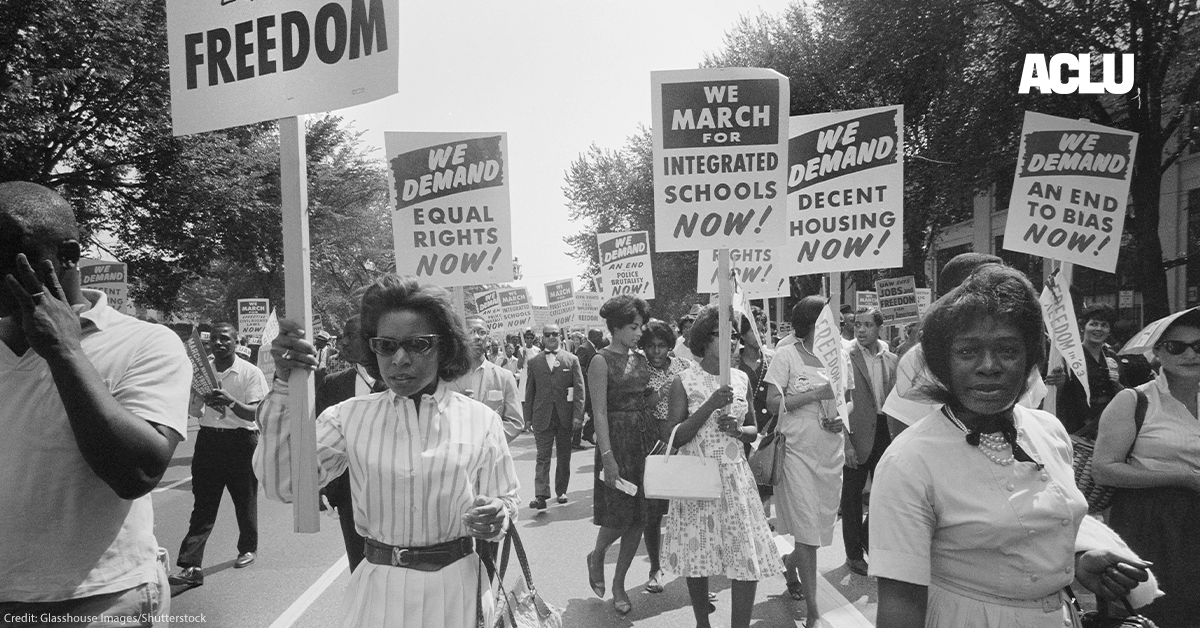
President Donald Trump began February with a proclamation that Black History Month offered “an occasion to celebrate the contributions of so many Black American patriots who have indelibly shaped our nation’s history.” In the closing days of the month, he hosted a Black History Month reception at the White House where he promised he would fight for Black Americans. What he did not mention during his remarks was that the proclamation and reception came amidst a systemic crusade to dismantle the civil rights infrastructure that Black Americans helped build and that sustains our hopes for equal citizenship.
One of the first moves Trump made after his inauguration was to issue a wide-ranging executive order ending the federal government’s diversity, equity and inclusion (DEI) programs and firing the public servants who lead that work. He has moved to end affirmative action programs in federal procurement. He has threatened colleges and universities, intimidated non-profit organizations, and removed Black and women leaders from the nation’s military leadership.
Across the country, Black History Month proceeded against the backdrop of relentless attempts to erase Black history. Enemies of justice have sought to erase history so that past injustices cannot be connected to present inequities. Those who fear racial equality have always understood the importance of silencing stories that give people the hope and the means to build a better future. This whitewashing is a clear and present danger to an inclusive democracy. If Americans do not reflect on slavery’s enduring legacy, on Reconstruction and its violent backlash, on Jim Crow and its transformation into modern mass incarceration, then they cannot fully understand why racial injustice persists today and they will not be equipped to fight it. Now, with President Trump in office, the wind is at their back as he and his allies attempt to bludgeon Black history and Black futures at the highest levels.
But this is not just about how we study history. Much of American history can be understood as the struggle to build an infrastructure of racial justice. That includes the fight to end residential segregation and connect communities of color to opportunity, and the fight to pass and enforce laws like the Reconstruction amendments and the Civil Rights Movement-era laws that sought to move Black Americans closer to the American dream. What we are seeing today is a full-scale attack on that infrastructure; the deeply interconnected systems that make racial justice victories real. This infrastructure includes laws grounded in the 14th Amendment’s promise of equal protection under the law and the benefits of citizenship regardless of race; enforcement structures like the Equal Opportunity Employment Commission or the Civil Rights Division of the Department of Justice; pathways to upward mobility like the federal workforce; social norms that ensure fair treatment in businesses; the network of activists, educators, and journalists who inform and organize; and, yes, the teaching of Black history. The very laws and policies that sought to bring us closer together are being rapidly dismantled.
The fight for racial justice has never been won by laws alone. Legal rulings can declare rights, but they cannot enforce them. Legislation can assert equality, but it cannot guarantee justice. What makes racial justice victories real is the broader infrastructure that brings together the power and rights embodied in law, the enforcement mechanisms of both our laws and our social norms and customs, and the strength of communities to fight threats to their families and neighbors. This was the infrastructure that allowed Charles Hamilton Houston and other pioneers to lay the legal groundwork for Brown v. Board of Education. It was the infrastructure that allowed the Voting Rights Act of 1965 to not just outlaw discriminatory voting practices, but also mobilize communities to claim their right to vote. It was the infrastructure that opened doors to education and economic opportunities that had long been denied to Black people. It is this infrastructure that continues to hold up communities around the country who are fighting against industrial projects that would pollute their air and transportation projects that threaten to flatten their homes.
Yet, this infrastructure—built over centuries—is fragile. Today, the news is full of stories about attacks on affirmative action,DEI and people of color who have managed to find some measure of success in traditionally white spaces. Legal decisions, particularly from Chief Justice John Roberts’ Supreme Court have undermined the effectiveness of laws such as the Voting Rights Act, which is responsible for broadly expanding the right to vote in the face of vicious restrictions on Black voting; and policies such as affirmative action in higher education, which has increased access to higher education for underrepresented racial and ethnic groups who face systemic barriers to education and admissions criteria that capture and magnify racial bias.
In many ways, this has always been the way of history. Progress has always been met with retrenchment. We take two steps forward, and then one step back. Yet throughout the country, activists, political leaders, lawyers, and everyday Americans are organizing to resist the retrenchment, as they have throughout American history. The infrastructure of racial justice is fragile, yes. But it is not broken. If we protect it, it will remain standing.