Virtual Ministry Archive

Showing posts with label breaking news. Show all posts

Via the ACLU: The Supreme Court Will Soon Determine Whether Cities Can Punish People for Sleeping in Public When They Have Nowhere Else to Go

The Supreme Court Will Soon Determine Whether Cities Can Punish People for Sleeping in Public When They Have Nowhere Else to Go

Cities all across the United States have been increasingly passing laws that punish people who are forced to sleep outside each night due a lack of available shelter and extreme housing shortages. The Supreme Court will soon decide if doing so violates the Eighth Amendment’s prohibition on cruel and unusual punishment, in a case that arose out of southern Oregon and is arguably the most significant case on homelessness in decades. The ACLU’s Scout Katovich explains how the case made its way to the highest court in the U.S. and breaks down the stakes – both for the hundreds of thousands of people who are unhoused on any given night and for critical constitutional protections.

Katie Hoeppner: Can you tell us how this lawsuit came about and how it got to the Supreme Court?

Scout Katovich: Sure. The case comes out of Grants Pass, Oregon, which, like many cities in America, is facing a shortage of affordable housing that has led to increased homelessness. In 2019, there were at least 600 unhoused people in the city. The city’s response was to pass a set of laws making it illegal to sleep in public anywhere, at any time. The city called some of these laws “camping bans,” but they weren’t really about banning tents or what we usually think of as camping. Instead, they prohibited sleeping outside while using anything that could be considered “bedding,” even just a thin blanket to keep from freezing at night, or a rolled up t-shirt used as a pillow.

The punishment for this “crime” was hundreds of dollars in fines, which could quickly escalate to a sentence of 30-days in jail. Grants Pass started fining and arresting unhoused people under these laws, even though the city had zero accessible shelters for adults. So, every night, hundreds of people had no choice but to sleep outside and break these laws. In essence, they were being punished for the unavoidable human need to sleep.

A group of unhoused residents of Grants Pass challenged the enforcement of these laws and a federal court ruled in their favor, holding that the city’s enforcement of these “anti-sleeping” and “anti-camping” laws against unhoused residents with no access to shelter violated the U.S. Constitution’s prohibition on cruel and unusual punishments. On appeal, the Ninth Circuit agreed with the lower court. Now that decision is being reviewed by the Supreme Court, and the justices will hear oral arguments in the case on April 22.

KH: A lot of cities across the country have similar bans. Can you tell us how the Supreme Court’s ruling could affect the large number of people all over the country who don’t have any choice but to sleep outside at night?

SK: That’s exactly right – we’ve seen a troubling uptick in these kinds of unconstitutional sleeping and camping bans all across the U.S. One study found that over half of the 187 cities it surveyed have laws restricting sleeping in public and almost three-fourths have laws restricting camping. The Supreme Court decision in Grants Pass will determine whether cities can use laws like this to punish unhoused people with no access to shelter, just for sleeping outside with rudimentary protections from the elements. This ruling could affect a huge number of people. With over 600,000 unhoused people and a shortfall of at least 200,000 shelter beds nationwide, hundreds of thousands of people have no choice but to sleep in public every night.

“With over 600,000 unhoused people and a shortfall of at least 200,000 shelter beds nationwide, hundreds of thousands of people have no choice but to sleep in public every night.”

If the Supreme Court rules for Grants Pass, cities could be empowered to treat all of those people as “criminals.”

KH: The stakes are clearly enormous. What is the ACLU’s involvement in this case?

SK: Absolutely, this is a really important case, both for unhoused people and for the constitutional principles at issue. We felt strongly that the ACLU should weigh in at the Supreme Court, in part because it’s part of our mission to protect constitutional rights, including the Eighth Amendment right to be free from cruel and unusual punishments. But we’re also deeply invested in protecting the rights of unhoused people and, in fact, the ACLU and its affiliates have brought lawsuits similar to the one before the Supreme Court, challenging enforcement of sleeping and camping bans in cities across the country, including Albuquerque, Honolulu, Phoenix, San Francisco, and Boulder. In this Supreme Court case, the ACLU and 19 of its affiliates submitted a “friend of the court” brief urging the Supreme Court to uphold the Ninth Circuit’s ruling that punishing unhoused people without access to shelter for sleeping in public violates the Eighth Amendment’s prohibition on cruel and unusual punishments.

KH: Can you explain why the Eighth Amendment is such an important focus of the brief and lawsuit?

SK: Yes, our brief explains that the Eighth Amendment’s original meaning and more than a century of Supreme Court cases make clear that the Cruel and Unusual Punishments Clause bars governments from punishing people in ways that are disproportionate to the crime. It may sound a little wonky, but it boils down to the idea that the Constitution places some checks on how the government can punish crime. Punishment must be appropriate to the seriousness of the crime and should only be as severe as is necessary to promote legitimate goals of our criminal legal system, like rehabilitation and deterrence. Applying these well-established principles to the Grants Pass case, any punishment for the “crime” of sleeping in public when you have no other choice is unconstitutionally excessive.

KH: Can you say how the Grants Pass case fits within the ACLU’s other work, for those who may not immediately think of homelessness as an ACLU issue?

SK: Well, first and foremost, the ACLU is committed to protecting the civil rights and liberties of all, and especially the most marginalized members of our society, which certainly includes unhoused people. And our society’s approach to homelessness has made it a criminal justice issue and an equality issue. When cities like Grants Pass choose to respond to homelessness with police and jails, it fuels mass incarceration, keeping people in an endless cycle of poverty, incarceration, and institutionalization. Rather than confront the decades of policy failures that have led to a dearth of safe and affordable housing, and access to healthcare, and other services, politicians and government officials blame individuals for our society’s failings and use criminal punishment to try to push people out of sight.

“Rather than confront the decades of policy failures that have led to a dearth of safe and affordable housing, and access to healthcare, and other services, politicians and government officials blame individuals for our society’s failings and use criminal punishment to try to push people out of sight.”

And that’s where the ACLU comes in. We can’t stand by and let governments choose ineffective “solutions” that trample on the rights and dignity of our neighbors. This is also an ACLU issue because homelessness intersects with many marginalized identities, compounding discrimination and the disproportionate harms that our criminal legal system inflicts on marginalized communities.

KH: That’s a really important point about compounding discrimination…

SK: Yes, people with disabilities, LGBTQ people, and people of color, especially Black and indigenous people, are far more likely to experience homelessness because of systemic inequality and discrimination. Their overrepresentation in both the criminal legal system and among the unhoused creates a vicious feedback loop – unhoused people have an increased risk of arrest and incarceration and, in turn, a jail or prison stay often leaves people without housing and employment, keeping them in homelessness. The ACLU has long been invested in ending mass incarceration and addressing inequities in the criminal legal system, and it’s clear that our society’s approach to homelessness is exacerbating both.

KH: You mentioned that elected officials “choose” the punitive approach. And I think that’s important to underline, because they often act as though their hands are tied. Can you say more about what elected leaders could actually do to meaningfully address homelessness?

SK: There’s so much they could be doing. But first, I just want to emphasize that the punitive approaches they are taking only make the situation worse. Criminal legal system involvement and homelessness are part of a vicious cycle. Arrests, citations, and jail or prison time don’t solve homelessness, they exacerbate it. These carceral approaches also cost taxpayers a lot of money. In 2015, Los Angeles spent $50 million policing anti-homeless laws and, in Seattle, enforcing just one of its “quality of life” laws cost the city $2.3 million over just five years. So we really need to call on elected officials to stop passing these laws and adopting policies that take this misguided approach. Instead, cities and states need to focus on policies that actually address the root causes of homelessness.

KH: I wish more elected leaders would show this courage. What specifically would address those root causes?

SK: First and foremost, they need to focus on investing in safe, affordable housing. The link between homelessness and unaffordable housing could not be clearer: the areas with the most unsheltered homelessness are also the most expensive housing markets. Addressing this is a long-term commitment, but it will pay off. There’s a lot of research demonstrating that providing permanent, affordable housing, coupled with accessible services, successfully ends chronic homelessness and also reduces arrests and incarceration. We also need to increase access to wrap-around supportive services, and voluntary mental health and substance use treatment, and adopt non-law enforcement responses to situations stemming from mental health issues and poverty. There’s strong evidence that these non-carceral approaches are cost-effective, reduce contact with the criminal legal system, and increase chances of obtaining housing and employment.

KH: Is there anything else you think people should know?

SK: Yes, I think it’s really important to underscore that homelessness is not a nuisance, it’s a symptom of our collective failure to invest in our communities. It’s uncomfortable for sheltered people to have to confront this failure, but the answer to that discomfort is not to temporarily push people out of sight through criminal punishments. Addressing homelessness in humane and effective ways helps everyone. So many of us are just one bad circumstance away from losing our homes.

“Addressing homelessness in humane and effective ways helps everyone. So many of us are just one bad circumstance away from losing our homes.”

Housing costs have skyrocketed while wages have not kept pace. We are also facing extreme housing shortages. As a result, there’s nowhere in the country where a person working a full-time minimum-wage job can afford even a modest two-bedroom apartment. So protecting unhoused people’s rights and adopting effective approaches to reducing and preventing homelessness is something we should all be invested in.


Published April 5, 2024 at 12:20PM
via ACLU (https://ift.tt/JemWGka) via ACLU
Via the ACLU: How We're Fighting for Gender Equity Nationwide

How We're Fighting for Gender Equity Nationwide

Across the country, our affiliates are challenging discriminatory policies and practices that disproportionately affect women, and particularly women of color. From housing discrimination in Illinois, to inhumane treatment of incarcerated pregnant individuals in North Carolina, and discriminatory dress codes in Texas schools, the ACLU and its affiliates are at the forefront of legal and advocacy efforts that promote gender equality and justice for all.

Here are three ways our affiliates are stepping up:


Illinois: Challenging Discriminatory Housing Policies

The ACLU of Illinois recently joined with national and local advocates, including the ACLU’s Women’s Rights Project, to challenge the “No-Evictions” policies of two large landlords — Hunter Properties and Oak Park Apartments — in Cook County, Illinois. These policies automatically reject rental housing applicants who have had any prior connection to an eviction case. The effect is to shut out families from housing opportunities, even when the eviction case was dismissed or filed years ago. Such policies have a discriminatory effect on Black renters, and especially Black women. Analysis of data from the Cook County Sheriff’s Office found that Black women accounted for approximately 33 percent of those served with an eviction case or evicted, despite making up just 22 percent of all renters in Cook County. Black renters in general faced nearly triple the likelihood of experiencing an eviction case than non-Black renters.

The lawsuit filed against Hunter Properties, and the civil rights complaint filed with the U.S. Department of Housing and Urban Development against Oak Park Apartments, argue their respective “No-Evictions” policies have a disparate impact on Black renters, especially Black women renters, that violate the 1968 Fair Housing Act. The complaint against Oak Park Apartments also asserts that its policy perpetuates and reinforces residential segregation in violation of the Fair Housing Act. The two filings are among the first in the nation to challenge landlords’ eviction screening policies as discriminatory.


North Carolina: Challenging Inhumane Practices for Incarcerated Women

In 2021, the North Carolina General Assembly finally passed a statewide law banning correctional officers, sheriffs, and other prison staff from shackling incarcerated people during critical periods of their pregnancy and postpartum journey. The law, HB 608, also known as Dignity for Women Who are Incarcerated, came after years of advocacy by the ACLU of North Carolina and several other partner organizations, including Planned Parenthood South Atlantic and SisterSong.

A pivotal factor in the bill’s passage was an OB-GYN’s moving account of delivering a baby to a shackled woman in custody. Labor and childbirth are already intense and vulnerable experiences, and the use of restraints can exacerbate the physical and emotional pain of the mother. This story deeply resonated, even with resistant sheriffs, ultimately propelling the legislation forward.

Despite the passage of this legislation, challenges persist. Recent revelations suggest some North Carolina prisons and jails have not been in compliance with the law. Undeterred, the ACLU of North Carolina is initiating a comprehensive awareness and compliance campaign, and will be filing public record requests with the jails in all 100 counties in North Carolina, coordinating legal education seminars for the criminal defense bar and developing content on the importance of reproductive justice and the need to uphold the rights of incarcerated individuals. With these efforts, the ACLU-NC aims to ensure adherence to the law and foster a deeper appreciation for upholding the dignity of pregnant people in prison and jails.


Texas: Challenging Discriminatory Dress Codes in Schools

More than half of Texas public K-12 school districts still have discriminatory dress codes and grooming policies. The ACLU of Texas has uncovered alarming disparities in school dress codes, revealing a trend of discrimination against students based on gender, race and ethnicity, LGBTQ identity, religion, disability, and socioeconomic background. The ACLU of Texas recently published a new report that reviews policies from 97 percent of Texas school districts and highlights pervasive inequalities within them.

Some of the survey’s major findings include:

  • More than 80 percent of districts enforce vague and subjective hair standards, which could lead to disproportionately penalizing Black students.
  • 53 percent of districts uphold dress codes rooted in outdated gender norms, such as boys-only hair length policies and girls-only sleeve length policies.
  • More than 80 percent of districts prohibit head coverings without explicitly noting or explaining the religious exemptions mandated by law, harming students of diverse faith backgrounds.
  • Nearly 80 percent of districts penalize students for wearing worn or improperly sized clothing, disproportionately impacting economically disadvantaged students.

In light of these disparities, the ACLU of Texas is taking action to challenge discriminatory dress codes and foster inclusive classroom environments. They’re sending the report to every district in the state to equip students, families, educators, and policymakers with knowledge that can help identify the harms of — and solutions to — discriminatory dress code policies. The report provides advocacy tools for community members and a roadmap for school districts, outlining recommendations like removing discriminatory dress code language, establishing fair enforcement practices, and providing clear and specific dress code guidelines. The ACLU of Texas is actively working in the courts and communities to push for more inclusive dress codes.

If you’ve faced or witnessed dress code discrimination, you can share your experience to continue this advocacy.

No student should ever be punished for being who they are. Instead of discriminating against young people, we should be preparing them for their futures.


Published March 27, 2024 at 08:54AM
via ACLU (https://ift.tt/FMApPn7) via ACLU

Via the ACLU: Why Allowing Chaplains in Public Schools Harms Students

Why Allowing Chaplains in Public Schools Harms Students

A 2023 Texas law allowing public schools to hire chaplains, or accept them as volunteers, to provide student support services has inspired more states to consider copycat legislation. In March 2024, the Florida Legislature passed a school chaplain bill, which now awaits the governor’s signature. Similar bills have been introduced in 13 other states: Alabama, Georgia, Indiana, Iowa, Kansas, Louisiana, Maryland, Mississippi, Missouri, Nebraska, Ohio, Oklahoma, and Utah.

Most of the proposed legislation authorizing school chaplains would allow chaplains to take on sensitive and critical responsibilities, such as counseling students, without the same qualifications as school counselors or other student support staff.

The ACLU, along with faith groups and other civil rights organizations, has vigorously opposed these efforts. Allowing chaplains in public schools violates students’ and families’ right to religious freedom. And, because chaplains are typically not trained or certified to provide educational or counseling services to youth, students are likely to receive inadequate mental health support that, in some cases, may be harmful.

Installing chaplains in public schools violates the separation of church and state.

Allowing public schools to establish paid or voluntary positions for chaplains will inevitably lead to evangelizing and religious coercion of students. This violates the First Amendment’s Establishment Clause, which, along with the Free Exercise Clause of the First Amendment, safeguards the constitutional right to religious liberty. Courts have repeatedly ruled that it is unconstitutional for public schools to invite religious leaders to engage in religious activities with students or to promote religious doctrine to them.

Chaplains are trained to provide spiritual guidance. They do not have the experience necessary to ensure that they adhere to public schools’ educational mandates and avoid veering into impermissible religious counseling and promotion of religion. In fact, many of the bills proposed across the country specifically state that school chaplains do not need the same qualifications or certifications as school counselors or staff who provide other support services for students. Exempting chaplains from the same professional requirements as other school staff makes clear that installing them in public schools is not about helping students, but is yet another effort to subject children to unconstitutional government sponsored religious indoctrination.

Allowing chaplains in public schools endangers students’ wellbeing.

Authorizing untrained and uncertified chaplains to engage in the same duties as school counselors will result in inadequate mental health support for students. In some cases, chaplains may provide inappropriate responses or interventions that could gravely harm students, including those experiencing mental health crises, LGBTQ students, and other vulnerable individuals. When a student seeks mental health care at school, that care should be provided by a qualified professional.

State lawmakers and school boards must reject school chaplain proposals.

School chaplain bills usurp the role of religious communities. Chaplains themselves have opposed these bills, arguing that they would “misuse the authority of chaplains of any religion” and “cause division among student bodies” that include students of myriad faiths as well as non-religious students.

These bills also undermine the fundamental promise of our public education system: Public schools must serve all students equally. The ACLU, together with faith groups, civil rights organizations, and chaplains nationwide, is pushing back against these unconstitutional efforts to impose religion on public school students. To ensure that our public schools remain safe and welcoming for everyone, state lawmakers and school boards must do the same.


Published March 15, 2024 at 09:24AM
via ACLU (https://ift.tt/rDiTFVO) via ACLU

Via the ACLU: "We Do No Such Thing": What the 303 Creative Decision Means and Doesn't Mean for Anti-Discrimination and Public Accommodation Laws

"We Do No Such Thing": What the 303 Creative Decision Means and Doesn't Mean for Anti-Discrimination and Public Accommodation Laws

Can a bakery that objects to marriage equality refuse to sell a cake to a gay couple for their wedding? This question, or some variant thereof, has occupied courts even before marriages for same-sex couples were legally recognized. In June 2023, in 303 Creative v. Elenis, the Supreme Court addressed this question in a case asking whether a wedding website design business could refuse to design websites for weddings of same-sex couples. The court ruled for the business. But properly understood, the decision does not license discrimination; it merely recognizes that where a business will not provide a particular product or service to anyone, it has the right to refuse it to a gay couple. That exception should not apply to most applications of anti-discrimination laws, which require only equal treatment, and do not require businesses to provide any particular service or product. As I explain in more detail in this Yale Law Journal article and as we argue in this model brief, 303 Creative does not create a First Amendment right to discriminate.

Can a bakery that objects to marriage equality refuse to sell a cake to a gay couple for their wedding?

Under Colorado’s public accommodations law, businesses that choose to serve the public at large cannot turn people away because of their race, sex, religion, sexual orientation or other protected characteristics. 303 Creative claimed that because its service is expressive and its owner objects to same-sex marriage, it can’t be required to provide website design services for same-sex weddings.

In a 6-3 decision, the court ruled for the business, concluding that Colorado’s application of its public accommodations law violated the designer’s First Amendment rights. In our view, the decision was wrong. We submitted a friend-of-the-court brief arguing that the Constitution did not give the business a right to refuse to comply with Colorado’s anti-discrimination law. But it’s important to understand the limits of the decision.

The case was brought by 303 Creative, a website design business, and its owner, Lorie Smith. Smith argued that Colorado’s law violated her First Amendment rights by compelling her, if she opened a wedding website design business, to serve both gay and heterosexual couples seeking to marry. The business had never actually designed a wedding website. Still, Smith brought the case before doing so, arguing that she was deterred from pursuing the business out of fear that Colorado’s public accommodations law would require her to create websites celebrating marriages that she opposed.

In a 6-3 decision, the court ruled for the business, concluding that Colorado’s application of its public accommodations law violated the designer’s First Amendment rights. In our view, the decision was wrong.

Because the case was brought before any actual application of the law, it was unclear what the designer would or wouldn’t do, or how the law would apply to her. As a result, the court’s opinions treat the case as if it presented two very different questions.

According to the majority opinion, the case involved a business owner unwilling to design for anyone a website whose content contravened her beliefs by expressly celebrating marriages of same-sex couples. It did not involve a business that refused services to customers based on their sexual orientation. Rather, Smith objected to the content of the message the state was compelling, not the identity of the customers. And equally significantly, the majority viewed Colorado’s purpose in applying its public accommodations law in such circumstances—where the business did not object to the identity of the customers but to the message requested—to be in suppressing disfavored ideas about marriage and compelling expression of the state’s favored viewpoint. In this particular application, the majority concluded, the business objected only to the message, and the state sought to enforce the law to compel a message–not to prohibit discriminatory sales on the basis of identity.

The dissenting opinions saw the case entirely differently. It viewed it as involving a website designer who objected to making any wedding website for a same-sex couple, regardless of its content. In its view, 303 Creative would refuse to make a website for a same-sex couple even if the website was identical to that of a different-sex couple. In its view, then, the designer sought a right to discriminate not based on the content of any particular message, but based on the customer’s sexual orientation. It correctly argued that the law has long been settled that the First Amendment does not permit businesses, even those whose services are expressive, to discriminate based on identity.

In essence, the majority and the dissent decided different cases. Indeed, when the dissent accused the majority of permitting businesses to discriminate on the basis of identity, the majority strongly rejected that conclusion, saying “We do no such thing.”

One way of understanding the difference is to imagine two paradigm cases. A t-shirt manufacturer that objects to making a t-shirt that says “Support Gay Marriage” has the right to refuse to make that t-shirt for a gay customer where his objection is to the message, not the identity of the customer. If the t-shirt manufacturer would not make a shirt with those words for anyone, it need not make one for a particular customer because they are gay. But at the same time, the t-shirt manufacturer could not refuse to sell a shirt saying “Love Marriage” to a customer because he was gay or sought to wear it to celebrate his marriage. If the business sells such shirts to others, it has to sell it to all. Nor could the t-shirt designer put up a sign saying “We Don’t Serve Gays.” In short, the decision permits a denial of service based on the message requested, but not based on who the product is for.

Understood in this light, the decision should have minimal impact on the enforcement of public accommodations and anti-discrimination laws. It recognizes a right to refuse service only where a business objects to expressing a particular message for anyone, not where it objects to serving certain customers because of their identity.

Because that is not the situation in the vast majority of instances in which antidiscrimination laws are applied, the decision leaves standing what the court previously described as the “general rule”—namely, that religious and philosophical objections “do not allow business owners and other actors in the economy and in society to deny protected persons equal access to goods and services under a neutral and generally applicable public accommodations law.”

In short, the decision in 303 Creative does not mean that a caterer, florist, or baker can refuse to provide food, flowers, or a cake for a wedding merely because the participants are of the same sex and the vendor objects to the implicit message providing those services sends. Instead, it is only when a public accommodations law compels speech that a business owner objects to providing for anyone—and does so in order to excise disfavored ideas, that it violates the First Amendment.


Published March 14, 2024 at 09:52AM
via ACLU (https://ift.tt/1wcHdR0) via ACLU

Via the ACLU: Supreme Court Signals that Institutions Can Keep Designing Programs to Foster Diversity, After Affirmative Action Ruling

Supreme Court Signals that Institutions Can Keep Designing Programs to Foster Diversity, After Affirmative Action Ruling

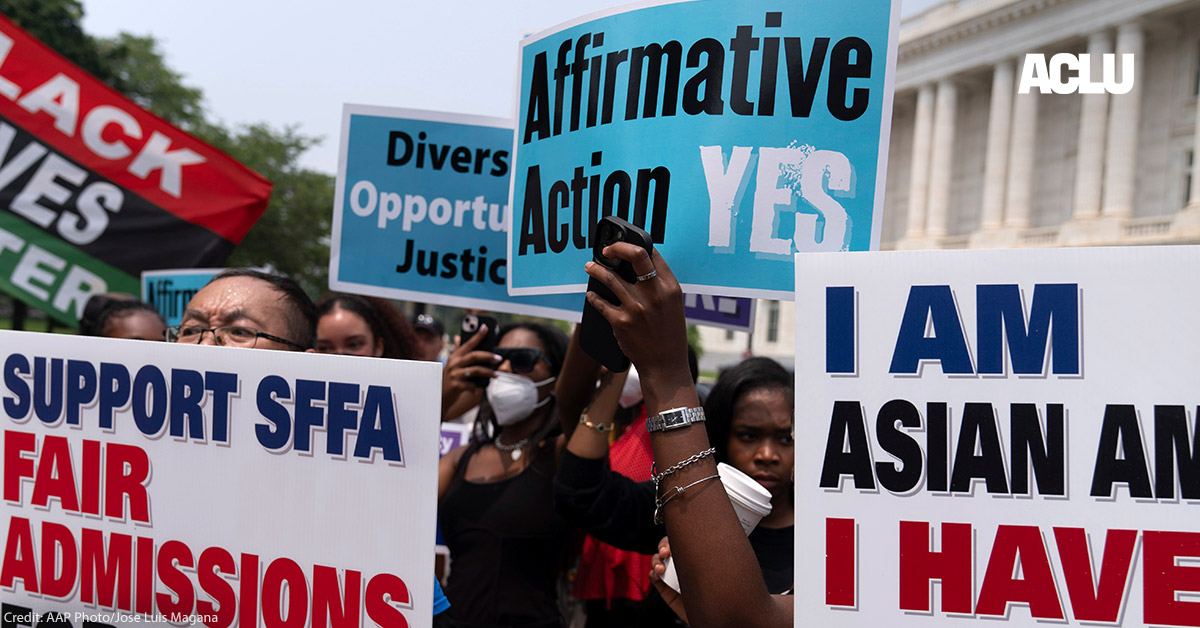
Since the Supreme Court struck down longstanding affirmative action admissions policies this past summer in SFFA v. Harvard/UNC, institutions from a variety of sectors have grappled with how to stay true to their commitments to equal opportunity in light of the court’s ruling. But this week, the Supreme Court did something noteworthy: it refused to hear a challenge to a high school admissions policy designed to eliminate unfair barriers for students of color. In doing so, the justices sent a signal that institutions can continue to find innovative ways to ensure equal opportunity for all within the parameters of their relatively narrow decision on affirmative action.

The admissions policy at issue in Coalition for TJ v. Fairfax County School Board, is just that — a thoughtful approach to ensuring that highly qualified students from all backgrounds have a fair shot at getting into Thomas Jefferson High School (TJ), the top public high school in Virginia. Recognizing the importance of a diverse student body, TJ removed arbitrary and unfair barriers to eligible Black, Latine and lower-income students of all races and ethnicities. Instead of relying only on standardized tests, which can exclude well-qualified candidates of color, the new process considers a broad range of factors, including performance on a problem-solving essay. The school also adopted a percentage plan that guarantees seats to the most competitive candidates from all eligible middle schools — not just select “feeder” schools in wealthy neighborhoods. By declining to take up the case, the Supreme Court has effectively let this policy stand.

And earlier this month, the court reinforced that its decision in SFFA was a narrow one, allowing West Point and the U.S. Naval Academy to continue their race-based affirmative action programs, while challenges proceed in the lower courts. Although the court did not explore the constitutionality of these programs, by declining to hear these challenges, it is leaving the door open for institutions to design creative solutions for expanding opportunity and fostering diversity.

This mission is more critical now than ever. Discrimination and deep-seated racial inequities that so many educational institutions, businesses, and other entities are working to address remain critical challenges. Since the 1990s, public education in the U.S. has grown significantly more segregated by race. Black and Brown students are more likely to attend schools that are doubly segregated: racially isolated and with fewer resources but higher needs. In the employment sector, Black workers face persistent gaps in promotion, pay, and opportunity. The Black-white wage gap was larger in 2020 than it was in 1970. Black, Latina, and Native women make less than 65 cents for every dollar earned by a white man, a differential that adds up to nearly a million dollars lost over the course of a woman’s career.

This reality was not lost on the Supreme Court. Even in its decision to strike down Harvard and UNC’s affirmative action policies, the court reaffirmed that the pursuit of diversity is a “commendable goals”. In his concurrence, Justice Brett Kavanaugh stressed that schools “can, of course, act to undo the effects of past discrimination in many permissible ways.”

That said, under the new legal landscape we face, opening the doors of opportunity will require careful construction, clarity of conviction, and steadfast commitment in the face of a well-resourced movement against progress. In designing programs to foster principles of fairness and equality, institutions need to be mindful that courts will pay more exacting scrutiny to programs that consider an individual’s race. Further, institutions need to be prepared to face highly organized attacks, including “warning” letters and legal challenges blatantly distorting the state of the law. These attacks have created a culture of fear and legal uncertainty specifically intended to coerce institutions into abandoning their commitments to equal opportunity — in some cases, successfully.

We cannot let this happen. Proactive efforts to ensure full and equal opportunity are more, not less, urgent in light of the Supreme Court’s decision. Institutions should examine their admissions, scholarship and fellowship programs, as well as recruitment and hiring practices, to ensure that they expand pipelines of opportunity for all. Schools, businesses, and others must not shy away from their DEI efforts, offices, and trainings, but instead should double down on the many lawful and effective approaches that remain. Schools and workplaces should take steps to foster a climate in which people of all races and ethnicities belong and can meet their full potential. And institutions must still comply with anti-discrimination laws, including those that prohibit unnecessary barriers to opportunity for people based on race or ethnicity. As the values of diversity and equal opportunity are themselves under attack, we must continue to push even harder for progress. It is not only the right thing to do, but what the law both permits and requires.

We need you with us to keep fighting
Donate today

Published March 6, 2024 at 01:59PM
via ACLU (https://ift.tt/91GQw5o) via ACLU

Via the ACLU: Despair and Resignation Are Not A Strategy: How to Fight Back In A Second Trump Term.

Despair and Resignation Are Not A Strategy: How to Fight Back In A Second Trump Term.

Many polls suggest if the presidential election were held today, Donald Trump could return to the White House. Fears of irreparable threats to our democracy and freedoms are neither abstract nor hyperbolic.

We must believe Trump when he reveals his authoritarian plans for a second term and take these threats seriously. He has made clear he intends to deploy the military to crush protests; activate state national guards to deport millions of immigrants; build on his legacy of gutting reproductive freedoms by implementing a nationwide abortion ban; create a police state in which anyone who he views as an “enemy” is surveilled and our law enforcement are further empowered to use lethal force; and undermine the integrity of our elections.

Terrifying as these threats are, despair and resignation are not a strategy. and our allies are prepared to fight back, informed by our experiences in his first term.


A Nimble Legal Strategy to Combat Every New Threat and Prevent Harm

The ACLU filed 434 legal actions against the Trump administration, and hundreds of other lawsuits were filed by sister organizations, state attorneys general and even private citizens.

We turned to the courts during Trump’s first week in office when we, with the International Refugee Assistance Project and other partners, filed the first lawsuit challenging Trump’s Muslim ban. We got our first win the day after Trump’s executive order was signed. As the administration pivoted to “perfect” its unconstitutional ban, we fought every subsequent version. Along with our allies, we defeated the first two iterations of the ban, and ramped up pressure for President Biden to revoke the third and final ban on day one of his presidency.

We employed a similar strategy when the administration started forcibly separating families at the southern border. Initially, we only wanted to reunite one mother and her daughter, but subsequently learned that the government had codified this horrific practice into standard policy. We quickly expanded our suit and did everything possible to have the full extent of this tragedy revealed to the public. We, Kids in Need of Defense, the Women’s Refugee Commission and Justice in Motion mobilized thousands of people to march in opposition. Under significant, sustained public and legal pressure, the administration finally reversed their family separation policy, with our lawsuit helping reunite approximately 3,200 families.

Litigation remains a powerful tool even in the face of Trump’s 245 judicial appointments. Much to his chagrin, many of his appointees proved willing to buck his agenda as Trump-appointed judges stood up nearly en masse for the rule of law and civil liberties in response to attempts to overturn the 2020 election results. Trump appointees also ruled against the administration’s anti-immigrant policies around Title 42 and the third-country transit ban.


Organizing Communities in the Streets

Should Trump return to the White House, advocacy organizations will need to come together like never before. No single organization will be able to stop the power of the federal government at Trump’s disposal. If he unleashes a deportation force to remove 13 million immigrants or deploys the National Guard to crack down on demonstrations, we and our partners will be in court daily challenging these unconstitutional and immoral policies. But that’s not enough.

Even more so than the first, the second resistance will be one of the people, not just lawyers. We will activate our 6.5 million supporters and our 54 affiliates in every state and territory. In partnership with grassroots organizations, labor unions, religious congregations and community leaders, we will exercise our First Amendment rights to mobilize the people in the streets, lobby in their statehouses, and advocate for local leaders to resist. General strikes, economic boycotts, and worker walk-outs will be critical tools to demonstrate that Americans will not sit idly by while a constitutional crisis is perpetrated.


Fighting Back in Congress, State Legislatures, and on the Ballot

In a second Trump administration, the public must force Congress to serve as a co-equal branch of government, not the lap-dog of the executive branch. We have to hold Congress accountable to do its job—keeping the pressure on through calls, lobbying, and grassroots visits, reminding them they work for us.

But fixing a broken Congress can’t just come from the Democratic Party. With the future of our democracy at stake, we need a bipartisan commitment to govern. We’ve seen glimmers of it. If a group of bipartisan Senators found common ground to reform the antiquated Electoral Count Act—which would now prevent Donald Trump, or any president, from pressuring their vice president to refuse certifying election results—surely they can agree to update the two-centuries old Insurrection Act and ensure its not abused by President Trump to shut down legitimate forms of dissent and debate.

As we ramp up the pressure on our representatives, the ballot box is where the people will get the final say. The Supreme Court’s Dobbs decision overturning Roe v. Wade—all thanks to a new Trump majority on the bench—illustrated the extent to which states are our last line of defense to bring forth the will of the people on issues such as abortion. And wherever reproductive freedom has been on the ballot since, we’ve won. Since Dobbs, we spent more than $23 million in key elections to protect abortion rights. This year, that playing field has significantly expanded: there are abortion ballot measures under consideration in Arizona, Colorado, Florida, Missouri, Maryland, New York, Montana, Nebraska, and Nevada.

Admittedly, ballot initiatives won’t be enough if Trump enacts a nationwide ban that restricts abortion services everywhere. But direct democracy efforts, through state constitutional amendments and local elections, will send strong signals that a power grab by the federal government will not be tolerated, and help make a case on states’ rights and federalism that might convince even conservative judges to limit these power grabs.

Trump and his allies have spent the last four years plotting his return and revenge. They will be more organized, deliberate, and aggressive. But if Trump does return to the Oval Office, the first “resistance” will look tame by comparison. Trump’s anti-liberty and fundamentally anti-American policies will assuredly be met with the full firepower of the ACLU, the might of our allies, and the commitment of the American people.

We need you with us to keep fighting
Donate today

Published March 6, 2024 at 10:57AM
via ACLU (https://ift.tt/UiLr25x) via ACLU

Via the ACLU: New York's Coercion of Private Companies to Blacklist the NRA Has a Long and Dark History

New York's Coercion of Private Companies to Blacklist the NRA Has a Long and Dark History

More than 60 years ago the Supreme Court ruled that the First Amendment bars the government from coercing private entities to punish speech that the government disfavors. Just as the government can’t directly punish or censor speech it disagrees with, it cannot do so indirectly by coercing private parties to do the same.

History underscores the importance of this free speech protection. Government officials have all too often enlisted private parties—from the White Citizens’ Councils of the Jim Crow South to the blacklists of Communists in the McCarthy era—to punish those with whom they disagree. New York’s efforts to punish the National Rifle Association, at issue before the Supreme Court in National Rifle Association v. Vullo, follow in the footsteps of those earlier censorship efforts.

The ACLU disagrees sharply with the NRA on many issues, yet we are representing the group in this case because of the First Amendment principles at stake.

The ACLU disagrees sharply with the NRA on many issues, yet we are representing the group in this case because of the First Amendment principles at stake. We argue that Maria Vullo, a New York state regulator, threatened to use her regulatory power over banks and insurance companies to coerce them into denying basic financial services to the NRA and, in Vullo’s own words, “other gun promotion” groups. Vullo’s threats were expressly based on her disagreement with the NRA’s advocacy. And they worked. Several insurance companies and banks refused to work with the NRA out of fear of reprisals from New York regulators. The ACLU urges the Supreme Court to hold that coercing third parties to break ties with the NRA because of its advocacy violates the First Amendment.

Even those who oppose government censorship may be sympathetic to New York’s efforts to shut down the NRA. The NRA is dedicated to promoting guns, which play an outsized role in violence and death in this country. The ACLU does not support the NRA’s mission. In fact, we directly oppose the NRA and support the government’s power to adopt sensible tools, like public carry permits and disarming persons subject to domestic violence protective orders. While it’s understandable that Vullo wanted to address the gun violence epidemic, government censorship wasn’t a constitutional response to the problem.

The right to advocate views the government opposes safeguards our ability to organize for the country we want to see.

The NRA’s case is hardly the first time government officials have sought to use private parties to penalize those with whom they disagree. Our nation’s history is replete with examples. And when the government threatens businesses in this way, the businesses often go along. As summed up by a slogan during the McCarthy Era: “Why buy yourself a headache?”

During the McCarthy era, from the late 1940s to 60s, the government regularly pressured private entities to fire people it perceived as connected with the Communist Party. The FBI and the House Committee on Un-American Activities delivered the names of employees who had alleged connections to “subversive” organizations, or even subscriptions to their publications, to private employers like defense contractors, universities, newspapers, and major corporations such as General Electric and U.S. Steel. Employers that failed to fire these employees faced loss of lucrative government contracts, necessary licenses, targeted investigations, and public smearing.

The ACLU itself has been the target of such efforts. In the late 1930s, Jersey City Mayor Frank Hague bragged that the reason the ACLU and the Congress of Industrial Organizations (CIO) had been unable to book a single private hall for meetings or speakers was because the hall owners are his “friends” and knew that he did “not approve of un-American groups coming into Jersey City.” The one hall owner who did rent his hall to the CIO for a meeting was then charged with a building violation. When asked about the violation at trial, Hague responded “Any port in a storm, Counselor”—effectively acknowledging that the violation was in retaliation for renting the private hall to a disfavored speaker.

The ACLU’s predecessor, the National Civil Liberties Bureau, confronted similar efforts during World War I. When the Justice Department attempted to put the Industrial Workers of the World (IWW) out of business by filing criminal charges against more than 100 members who had called for labor strikes, accusing them of undermining the war effort, the National Civil Liberties Bureau placed an advertisement seeking funds for the IWW’s “right of a fair trial.” The government responded by coercing The New Republic, a privately-run media company, to support its goal by threatening to revoke the magazine’s second-class mailing privileges if it reprinted the message.

Southern states turned to this tactic in their resistance to racial integration established in Brown v. Board of Education. Some states mandated public disclosure of the National Association for the Advancement of Colored People’s (NAACP) members, and relied on private entities that shared the state’s commitment to maintaining white supremacy, such as the White Citizens’ Councils, to publicize the disclosures to private business owners who were expected to then punish those named. As a result, NAACP members were fired, denied credit, prohibited from purchasing goods, evicted or had their home loans foreclosed, and subjected to threats of and actual violence. This public-private partnership became a blueprint for how to use racialized violence as an “economic cold war” to render both Black and white supporters of the NAACP “destitute” and undermine their ability to advocate for racial justice.

Nor is this tactic a relic of the past. In Florida, Gov. Ron DeSantis directed the state agency in charge of liquor licensing to see if it could stop private entities hosting performances of “A Drag Queen Christmas.” After the shows went forward, a non-profit theater venue in Orlando and the Hyatt Regency Miami faced actions to revoke their liquor licenses for allegedly violating laws prohibiting lewdness, vulgar exposure of sexual organs, and obscene performances—despite the agency’s own undercover agents attending and reporting that there were no “lewd acts” or “exposure of genital organs.”

Maria Vullo followed the same playbook. As the state’s top financial regulator, in coordination with then-Governor Andrew Cuomo, she expressly targeted the NRA for its “gun promotion” advocacy and urged all the banks and insurance companies she regulates to refuse to do business with the NRA. She offered leniency to one insurer for legal infractions if it would cut its ties to the NRA, and extracted promises from the NRA’s three largest insurance partners never to provide “affinity insurance” to the group’s members ever again.

NRA v. Vullo isn’t just about the NRA. It’s about all of our First Amendment rights to advocate for causes we believe in, without being targeted by public-private ventures of retaliation. If New York can do this to the NRA, then Oklahoma could similarly penalize criminal justice reformers advocating for bail reform, and Texas could target climate change organizations advancing the view that all fossil fuel extraction must end. The right to advocate views the government opposes safeguards our ability to organize for the country we want to see. It’s a principle the ACLU has defended for more than 100 years, and one we will continue to protect from government censorship of all kinds, whether we agree or disagree with the views of those being targeted.

Stay informed about our work
Sign up

Published March 4, 2024 at 09:50AM
via ACLU (https://ift.tt/IPr5oft) via ACLU

Via the ACLU: 4 Ways the ACLU Continues to Fight for Gender Equality

4 Ways the ACLU Continues to Fight for Gender Equality

In 1987, 15 years after the Women’s Rights Project was established at the ACLU, March was officially designated as Women’s History Month in the United States. This time is for the celebration of the women whose contributions and achievements have shaped our society. Such a celebration may feel painful at this moment, when we are facing the fall of Roe v. Wade, the Black maternal mortality crisis, as well as ongoing, systemic barriers including the gender wage gap, family policing, lack of affordable housing, and sexual harassment. Yet it is precisely at times like these we need reminders why we still fight – and that we still win. In the perpetual fight for justice and equity, women have not only been essential, but have also consistently led the way. Each March, we must celebrate the progress made, and acknowledge all the work that has been and has yet to be done.

For over 50 years, the ACLU’s Women’s Rights Project (WRP) has been at the forefront of the fight for gender justice. And just as Women’s History Month continues to evolve each year, our work has expanded and developed, with a focus on taking an intersectional approach. Here are four ways we continue to fight for equality:

1. Challenging Discriminatory Dress Codes

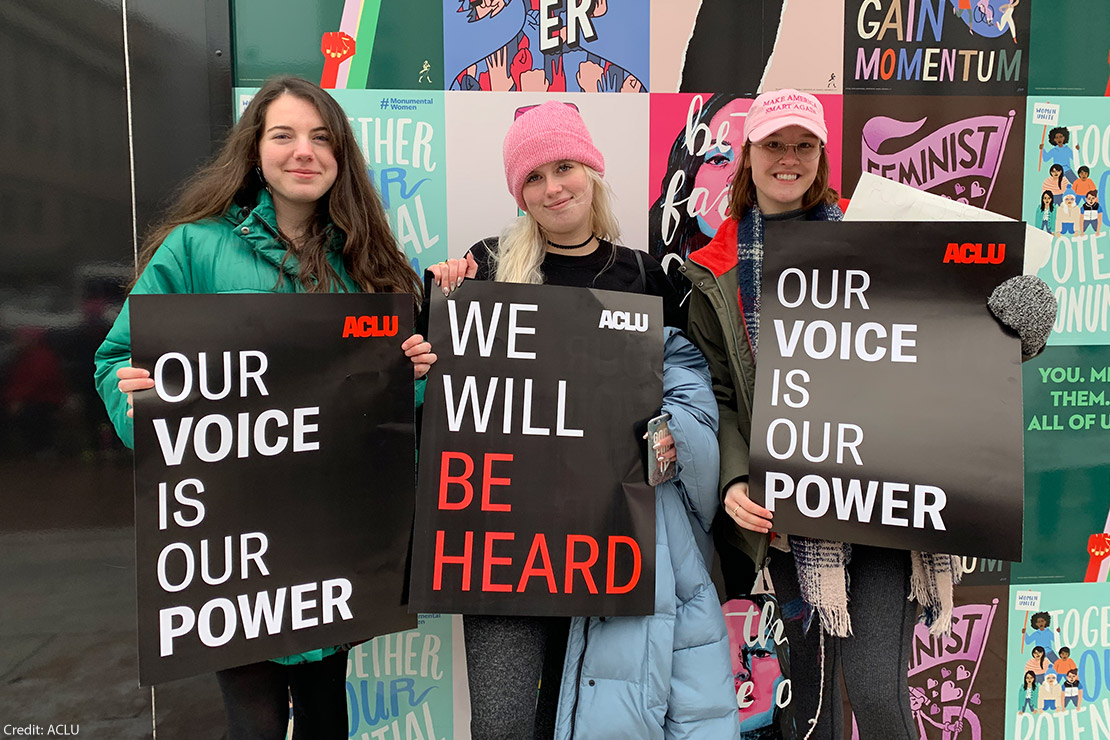
Three individuals holding ACLU branded posters.

The ACLU has led the way in fighting discriminatory dress codes that reinforce sexist and racist stereotypes in schools and at work. These discriminatory codes target girls, people of color, and members of the LBGTQIA+ community, particularly girls who live at the intersection of those identities. Many students and workers across the county are subject to senseless, sex-based restrictions such as skirts, dresses, and “modest clothing” for women and girls and short hair, pants, and no accessories for men and boys. We successfully challenged a charter school’s “skirts only” rule for girls, which the school adopted based on the belief that every girl is a “fragile vessel.” The school sought to overturn the decision but, in 2023, the Supreme Court left the victory in place. This past year, we also reached a historic settlement with Alaska Airlines to remove all gendered restrictions from its uniform policy for flight attendants.

Across the country, we’ve sought to end the enforcement of discriminatory dress codes in a range of other contexts as well. We’ve fought to end discriminatory dress codes in schools that prevent boys and non-binary students from wearing their hair long, which prevents Native American and Black students, among others, from expressing their cultural and religious traditions. We’ve also worked to end dress codes that penalize student athletes on the girls’ cross-country teams for training in weather-appropriate clothing, as well as those that forbid transgender seniors from attending their high school graduation dressed as themselves.

2. Taking on Housing Policies that Blacklist Black and Brown Women

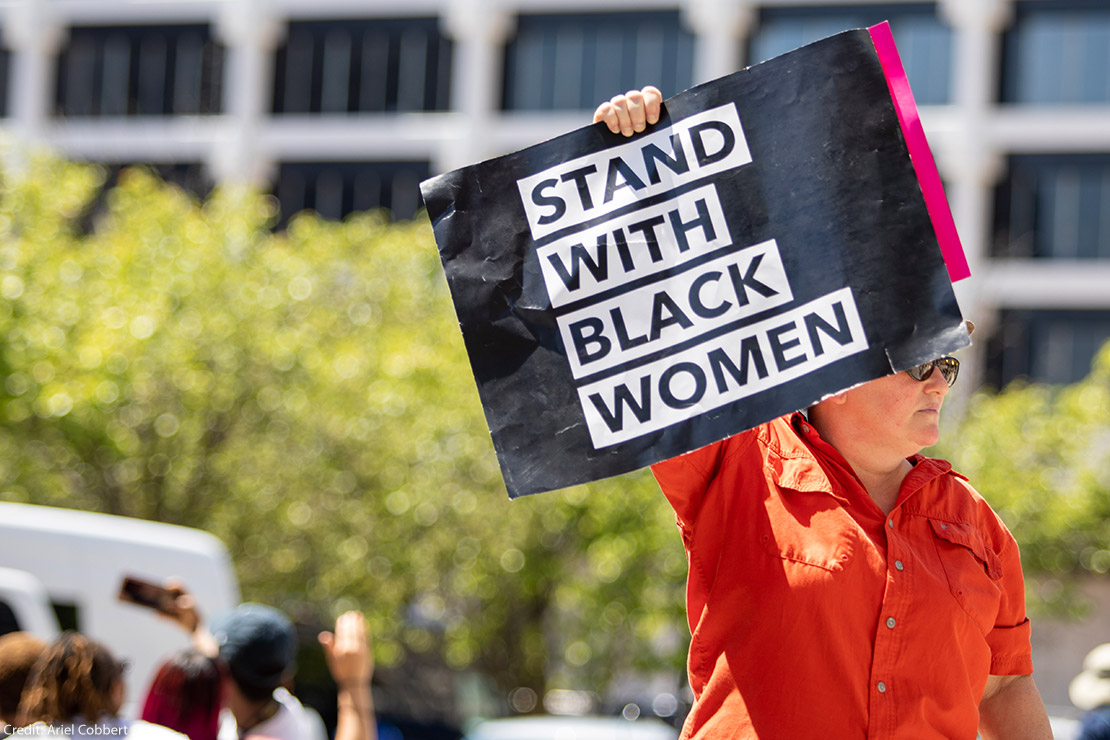
Someone holding a sign saying Stand With Black Women.

In our fight for housing justice, we have taken on “No-Eviction” policies and other screening policies that disproportionately discriminate against Black renters, particularly Black women. These screening policies block potential renters from housing simply because they are connected to any previous eviction case, even if the case was very old, they ultimately won it, or the legal action against them was unlawfully filed in the first place. Black women are significantly more likely to have eviction cases filed against them by landlords, so these policies in turn impact and destabilize Black women, further perpetuating systemic inequality and segregation. In 2023, we filed two challenges against the use of these screening policies by Chicago-area landlords. These cases were among the first of their kind in the United States and aim to set a precedent for disrupting discriminatory housing practices.

3. Advocating for Pregnant and Lactating Workers

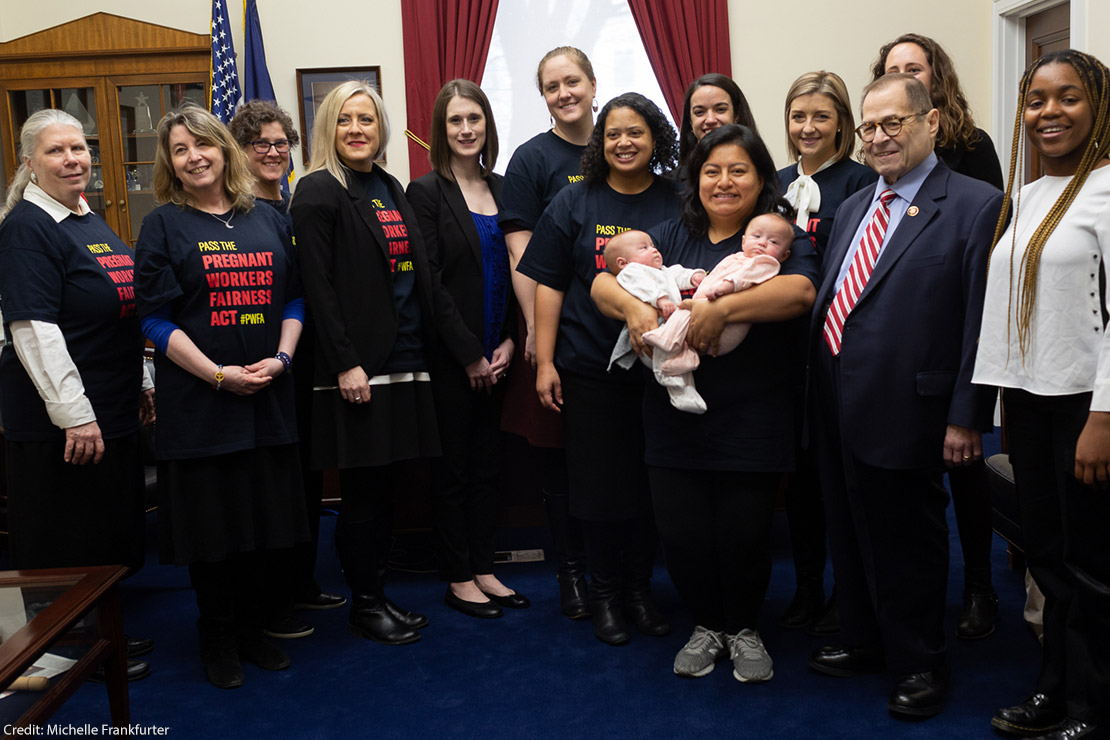
A group of women wearing t shirts saying Pass the Pregnant Workers Fairness Act.

We have long been at the forefront of fighting for the rights of pregnant and breastfeeding workers who experience discrimination in the workplace. Over the past few years, the ACLU was a key advocate for the enactment of the Pregnant Workers Fairness Act and the PUMP for Nursing Mothers Act. These new landmark laws ensure that millions of pregnant and lactating workers have access to reasonable accommodations that allow them to continue working, instead of forcing them to choose between their paycheck and a healthy pregnancy and nursing period. We continue to litigate on behalf of employees who are denied pregnancy-related accommodations and those discriminated against for being pregnant.

4. Fighting the Separation of Black and Brown Families

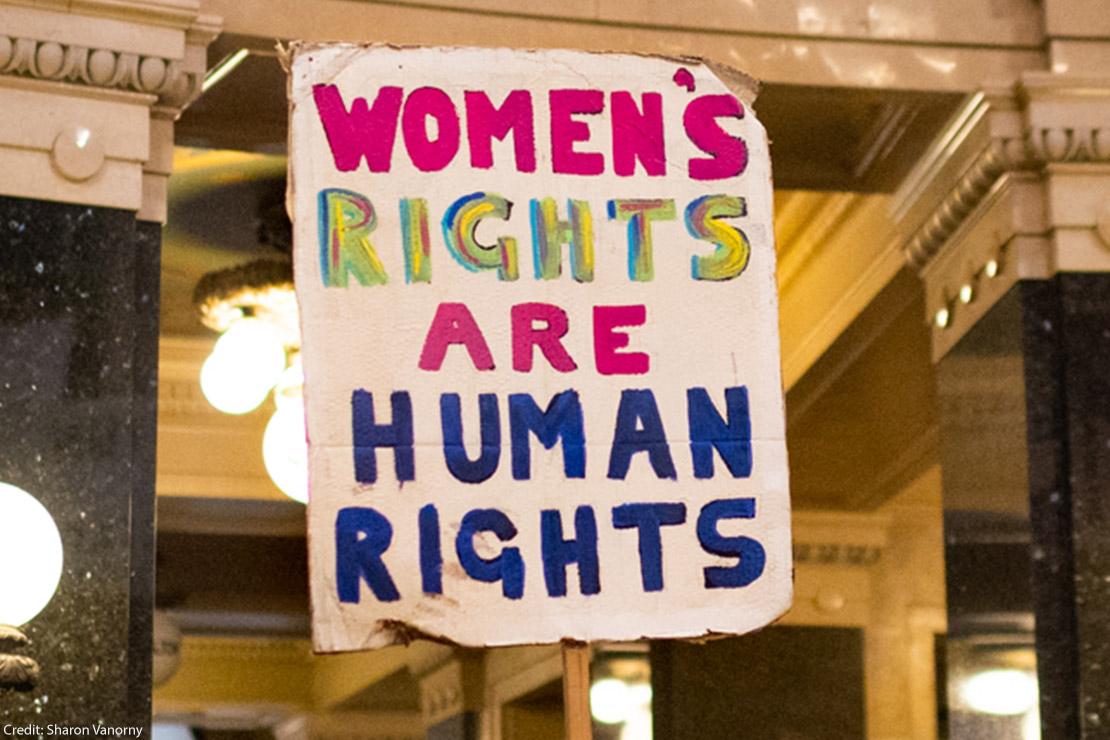
A sign that says Women's Rights Are Human Rights.

As part of our work on behalf of families of color who are disproportionately impacted by the child welfare system, we have been a strong voice in raising awareness about the widespread use of automated tools by local governments to determine which families to investigate – tools that often heighten the risk of disintegration for Black and Brown families in the United States. In 2023, the ACLU published a report on the discriminatory effects of Allegheny County’s “Family Screening Tool,” which could disproportionately flag family members who were Black or had disabilities for investigation. The ACLU’s report prompted in-depth reporting from the Associated Press and an investigation from the U.S. Department of Justice.

While there is still much work ahead of us, our recent victories give us hope for progress toward a more equitable world for everyone, regardless of gender. We will continue the fight for gender justice alongside everyone who has been and continues to be a part of the movement with us.

We need you with us to keep fighting
Donate today

Published March 1, 2024 at 09:59AM
via ACLU (https://ift.tt/kalV4mn) via ACLU

Via the ACLU: President Biden's Order to Ban Private Prisons Faces a Persistent Internal Challenge: The U.S. Marshals Service

President Biden's Order to Ban Private Prisons Faces a Persistent Internal Challenge: The U.S. Marshals Service

At the onset of President Biden’s term, in January 2021, he issued an executive order to phase out the federal criminal system’s use of for-profit prisons. This was an important step toward stemming the flow of federal money to corporations that lock people up for profit. The executive order covered both the Federal Bureau of Prisons, which holds people convicted of crimes, and the U.S. Marshals Service, which holds people while they await trial or await transfer to a federal prison after sentencing. However, it left out the federal government’s heavy use of for-profit immigration detention facilities, which are rife with abuse, unsanitary conditions, and overcrowding.

The Bureau of Prisons followed the executive order and has closed all of its for-profit prisons. The Marshals Service has not. An ACLU analysis of documents produced in response to a Freedom of Information Act request shows that, despite the executive order, the Marshals Service continues to hold nearly a third of its entire detention population in for-profit facilities, totaling 20,000 people. It does this by exploiting two loopholes it has created that undermine the purpose of the executive order: to end prison profiteering.

First, the Marshals Service has obtained repeated waivers from the White House that allow it to ignore the executive order and keep five for-profit facilities open. The Marshals Service and White House have not publicized these waivers, and when internal government investigators asked for documentation of these waivers, they were “told that no such documentation existed.”

Second, the Marshals Service has determined that it can continue to pay corporations to operate detention facilities for profit, so long as it uses a city or county government as a middleman. Under this arrangement, known as a “pass-through” agreement, the Marshals Service pays a city or county government, which keeps a portion of the payment and passes along most of the payment to the corporation that runs the facility. An internal government investigation found that these agreements cost the Marshals Service more and provide less control and oversight over operations at its detention facilities.

By using these two loopholes to keep funneling money to corporations that profit from incarceration, the Marshals Service perpetuates the harm that these corporations cause. In the words of President Biden’s domestic policy advisor: “Private prisons profiteer off federal prisoners and are proven to be, or found to be by the Department of Justice inspector general, less safe for correctional officers and prisoners.”

A statistical analysis has shown that as states turn more to for-profit prisons, their incarceration rates increase. This should come as no surprise: for-profit prison companies use the taxpayer money they receive to lobby extensively for increased incarceration. The two largest for-profit prison companies spent $1.7 million and $1.3 million lobbying the federal government alone, with more money going to state lobbying. This does not include the for-profit prison industry’s significant donations to political campaigns and PACs. For example, these two companies each spent a quarter million on President Trump’s 2017 inauguration festivities, and one donated $225,000 to a pro-Trump super PAC.

Congress has taken notice. Nine senators wrote a letter to “express deep concern that the [Marshals Service] appears to be circumventing President Biden’s Executive Order.”

There are a few concrete steps that the Biden administration and the Marshals Service can take now to address these problems and plan for an orderly transition away from for-profit prison companies. First and foremost, they should work together to divert people away from pre-trial detention in a way that protects community safety and ensures people show up for their trials. With fewer people to detain, the Marshals Service will have less need to pay for-profit facilities.

The Biden administration and Marshals Service should also work to find viable alternatives to for-profit facilities for those who remain in detention, where people can be held near their families, friends, and lawyers. People have a right to confer with their attorney regularly to prepare a defense, and numerous studies show that proximity to loved ones and support networks supports better outcomes when people are released from custody.

As they do this, they should be transparent. The Marshals Service should publish its plan to close the five for-profit prisons with which it continues to directly contract. It should develop a plan to stop using pass-through intergovernmental agreements and publish a plan to phase out these detention facilities as well. Spending taxpayer dollars to enrich private corporations and shareholders who run facilities with abusive practices, poor medical care, and unsanitary conditions is a policy that harms incarcerated individuals and creates unsafe working conditions for correctional officers. The Biden administration has called for an end to this policy, it is past time for the Marshals Service to listen.

We need you with us to keep fighting
Donate today

Published March 1, 2024 at 07:40AM
via ACLU (https://ift.tt/nFWcNGh) via ACLU

Via the ACLU: A Teenager’s Fight Against Idaho’s Harmful Ban on Gender-Affirming Healthcare

A Teenager’s Fight Against Idaho’s Harmful Ban on Gender-Affirming Healthcare

Two transgender adolescents and their families are challenging Idaho’s 2023 law, HB 71, which criminalizes gender-affirming medical care for trans youth. Signed by Governor Brad Little, HB 71 prohibits widely accepted treatments for gender dysphoria, despite their endorsement by leading medical organizations like the American Medical Association. In a lawsuit filed by the ACLU and legal firms, plaintiffs argue that the law violates constitutional rights. The law bans puberty blockers, hormone therapy, and certain surgeries for transgender youth, threatening medical providers with felony charges and up to 10 years in prison.

In February 2023, Idaho filed an application to the Supreme Court of the United States for a partial stay against an injunction currently blocking enforcement of HB 71. Jane Doe, a 17-year-old transgender girl living in Idaho and plaintiff in the case alongside her parents, shares her story.

All I Want is to Just Be a Teen

Despite everything, I know I’m lucky. Despite having to watch as politicians in my home state of Idaho and across the country spread lies targeted at transgender youth like me, I know I’m blessed with a family that loves me, friends that support me, and a school that protects my right to be treated like every other student. Despite my governor signing a law threatening to put my doctors in prison just for providing me with medical care I need, I know I’m lucky to have those doctors who, with the support of my parents, have helped me get the hormone therapy I need to address my gender dysphoria, which had been making my life unbearable. And despite needing to join a federal lawsuit against that law that threatens to uproot my entire life and family, I know my parents and my siblings would do anything to protect me no matter what.

As a 17-year-old girl, I haven’t even graduated high school. I should be planning for college, hanging out with my friends, and playing video games with my brother. Instead, politicians in my state have forced me to go to court to stop them from denying me the medical care my doctors, my parents, and I all know has saved my life. Now, that fight is at the Supreme Court where the Idaho Attorney General has asked the court to intervene and allow the ban on gender-affirming medical care to go into effect while the case goes forward. I do not want to be doing this. I just want to be a teenager and continue receiving the healthcare that has made the life I am now living possible.

For as long as I can remember, I knew that something felt off about living as a boy. I have always naturally related to other girls, felt the most like myself around other girls, and had similar interests as other girls. When I was younger, I did not have the words to express my feelings related to my gender identity or being transgender. But I knew it even before I knew the words for it. When I would play “make believe” with my friends, I was always a girl character. When I would play video games, I would always choose a girl avatar. My mom and dad even told me that, when I was little and my mom was pregnant with my younger sibling, I would lie down and place a doll on my stomach and tell them that I wanted to be a mom.

When I started middle school and my body started changing, the sense that something was “off” gradually became a devastating level of distress. My mental health began to deteriorate as the changes to my body made me look more like my older brother and less like the girl I knew myself to be. I avoided anything social and my grades began to fall. There were times that I simply just did not want to exist because the physical changes to my body were trapping me in an existence I knew was causing me immense mental pain.

Family, Friends and Community

At 14, I shared these feelings with my parents who, by then, could tell something was gravely wrong. Without hesitation, they told me they loved me, would always love me, and just wanted me to be happy and healthy no matter what. Soon after, I started “socially transitioning”–I started going by a new name at home and at school and my friends began using feminine pronouns to refer to me. I wore a feminine hairstyle and I started wearing girls’ clothes. I told my mom I wanted to wear makeup and, as part of how she supported me when I asked for her help, she taught me about makeup and how to apply it.

All of this helped my gender dysphoria, but I was still experiencing male puberty, which was causing significant physical changes to my body that I could not hide or cover up with makeup or clothes. The changes to my body caused me so much pain that sometimes I wished I did not even exist. My parents took me to see our family doctor, a pediatrician who’s known me all my life.

“From the moment you were born,” my doctor told me, “my job has been to make sure you’re healthy and happy, and this doesn’t change anything.” She referred us to a specialist with expertise in gender dysphoria and I started seeing a therapist. The specialist evaluated me, including an extensive conversation about my struggles with my gender. He also provided my parents and me information about gender affirming medical care, including the potential risks, and options to preserve fertility. At 15 and with my mom and dad’s support, I started medication that prevented further changes to my body from puberty, causing immediate relief to my anxiety and giving me much-needed hope. A few months later, I started estrogen, which has allowed me to go through puberty consistent with my gender identity.

“It’s hard to overstate how impactful gender-affirming medical care has been for me.”

It’s hard to overstate how impactful gender-affirming medical care has been for me. Before treatment, I was isolating myself, depressed, anxious, and I regularly felt trapped and scared. I could not see a future for myself. I am so grateful that when I told my parents about what I was experiencing, they listened to me, trusted me, and took me to providers who could give me the gender-affirming health care that I needed to be who I am. Combined with the support of my friends and school, the love and support I’ve received from my family is what every transgender kid needs and deserves.

At the start of 2023, the Idaho State Legislature began debating HB 71, a law that would ban my medical care and even threaten to put my doctors in prison for the “crime” of supporting me. It was both terrifying and infuriating to watch as something so important to me and my life was debated by people who obviously didn’t know anything about us. They didn’t seem to care at all about all the testimonies from parents like mine, the expertise of doctors like mine, and the pleas from trans kids like me begging the state not to take away the care that has saved my life and the lives of so many others. When Governor Brad Little signed the law, my parents and I were terrified for our future.

When HB 71 passed, my parents talked to my siblings and me about trying to travel out of state for care or selling our house and leaving Idaho-the only home I’ve ever known. Having to move would mean losing my friends, my family, my home, my community, my school–everything that I have always known.

I don’t want politicians trying to control my body, my life, and my family’s lives. And I don’t want any other trans kids to be faced with the same. I’m so fortunate to have the support I have-especially when so many trans kids are denied the same opportunity to thrive–and I wake up every day thankful for the love of my parents and my siblings. But if the Supreme Court allows this law to take effect, my family and my doctors understand that this health care is so central to my well-being that not receiving it is not an option. I ask that the Court please help me and my family. Please do not let my health care be taken away.

What you can do:
Protect Trans Care Now
Send your message


Published February 29, 2024 at 12:53PM
via ACLU (https://ift.tt/m0l8g4z) via ACLU